


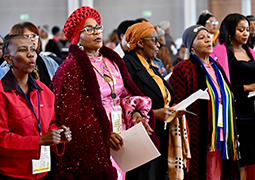
Gathering in Kimberley at Sol Plaatje University’s Great Hall during the Women’s Parliament to commemorate decades of women’s struggle for gender equality and equity, women parliamentarians, the Speaker of the National Assembly, Ms Thoko Didiza, and women from every walk of life united in a historic call for action: Wathint’ Abafazi, Wathint’ Imbokodo. Its melody and lyrics vividly evoked the valiant sacrifices that shaped the courage and conviction of their forebears in the face of apartheid brutality.
This call is the evocative theme of this year’s Women’s Parliament: “Wathint’ Abafazi, Wathint’ Imbokodo: 70 Years of Resistance, 72 Years of Vision – Advancing Gender Justice, Equality and Resilient Economies for All.” The gathering carries the weight of this enduring history and the urgency of the present. It marks 70 years since more than 20 000 women marched to the Union Buildings in 1956 to protest against apartheid pass laws, and 72 years since the 1954 Women’s Charter boldly imagined a country where women would stand as equal citizens to their male counterparts. That cause is as relevant today as it was when women’s formations and movements were conceptualised in 1954.
As a result of this event, Kimberley will this week become more than a historic diamond city. It will become a living chamber of memory, courage and expectation as women from across South Africa gather for the 2026 Women’s Parliament at Sol Plaatje University’s Great Hall from 13 to 14 August.
The interludes of this call evoke emotions and affirm that the metaphorical and literal rock has not been cracked. It remains solid and is now a bedrock upon which to advance women’s equality and social justice. This reinforces the fact that the historic struggle of women of yesteryear must not be remembered as a faded photographic memory, but as an inspiration for work that remains unfinished.
In anticipation of what lies ahead, women walked into the hall in doeks, dresses, uniforms, union T-shirts and traditional regalia; to the rhythm of songs that have travelled through generations; and in the voices of women who know that freedom, when deferred, must be demanded and reclaimed again.
It is this enduring memory that has brought together women from civil society, traditional leadership, faith-based organisations, labour, academia, youth formations and communities to observe this year’s Women’s Parliament and carry the torch of their forebears.
Their task is both commemorative and reflective, celebratory and analytical: to honour the women of 1956 while asking why, seven decades later, many women still face poverty, unemployment, exclusion from decision-making, gender-based violence and limited access to economic opportunity.
This gathering is also set to look back to the Women’s Charter of 1954, the democratic commitments made after 1994, and the renewed aspirations of the 2021 Women’s Charter. But it will also look forward, measuring those promises against the National Development Plan 2030 and the African Union’s Agenda 2063. In that sense, Kimberley becomes a site of accountability: a place where constitutional principles of women’s equality meet lived experience.
As the event unfolds over two days, there will be no shortage of difficult questions. Have laws and institutions translated into safety for women in villages, townships, farms and cities? Have gender equality programmes changed the daily realities of women entrepreneurs struggling for access to markets, women workers seeking fair wages, young women fighting for education and job opportunities, and survivors of violence demanding justice? Has Parliament’s oversight muscle been strong enough to ensure that resolutions do not gather dust?
At its heart, this Women’s Parliament is about turning remembrance into responsibility and responsive action. The phrase Wathint’ Abafazi, Wathint’ Imbokodo is more than a political slogan or melody; it is a clarion call, a warning and an expression of optimism born of this decades-long struggle. If anything, this call continues to remind South Africa that women have never been passive recipients of freedom. They have organised, marched, negotiated, resisted and advanced its cause.
In Kimberley, the legacy and vigour of this historic call to resistance and struggle will be renewed in the language of gender justice, resilient economies and equal citizenship. If the event succeeds, it will not only produce speeches and resolutions; it will sharpen the national demand for implementation, budgets, monitoring and consequences. It will insist that empowerment must be visible in boardrooms, council chambers, classrooms, police stations, courts, businesses and homes.
As women gather beneath the Northern Cape sky, the spirit of 1956 will not simply be remembered. It will be summoned. And once again, the country will be asked to listen carefully when the rock speaks.
Abel Mputing
13 August 2026
 Arrange a tour