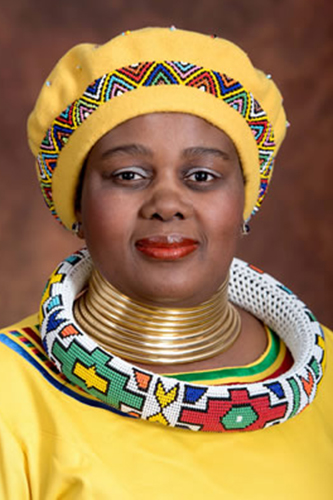



*Find the audio of Ms Ramolobeng’s brief to the media: https://iono.fm/e/1573618
Thank you Mr Mothapo.
Good day to you, my fellow committee Chairpersons, members of the media, and most importantly, fellow South Africans.
I want to begin my session with the review of the Correctional Services Act 111 of 1998.
The committee is pleased that the Department of Correctional Services will be reviewing the Correctional Services Act, 111 of 1998. This will also enable the committee to provide input on areas that it believes should be amended or strengthened, including Section 73 of the Act, which deals with the management of foreign national inmates in our facilities. We heard during the budget debate that the minister indicated there were 24 000 foreign national inmates in correctional centres across the country, which costs the state R11 million per day. The committee is seriously concerned that our correctional facilities have so many foreign nationals, but our country has not entered into an inmate exchange programme with any country. We intend to review this provision specifically as it relates to the incarceration of foreign nationals. We want to provide for foreign nationals serving life sentences to serve their sentences in their countries of origin due to the costs associated with housing foreign inmates in correctional facilities. We encourage the minister to consult further with the Minister of Home Affairs regarding the intention to review this provision.
Chairperson, I would like to now move on to Remand Detainees with Bail of less than R1000.
The Department of Correctional Services has a total of 166 008 inmates in correctional centres across the country, of which 104 117 are sentenced, and 61 891 are remand detainees. Remand detainees are the biggest contributor to overcrowding in correctional centres. We are concerned about the staggering cost of keeping and maintaining remand detainees in correctional facilities, which currently costs the department R482 per day and just above R13 000 per month for each detainee. Taking into consideration the pressing issue of overcrowding in our correctional facilities, many remand detainees are in the centres for months and years simply because they cannot afford to pay bail, which at times is as low as R300. We cannot have a system that further perpetuates the injustices that our constitutional democracy so desperately tries to correct.
It is in this context that we congratulate the Judicial Inspectorate for Correctional Services (JICS) for their efforts to undertake a feasibility study on a pilot bail fund project for remand detainees with a bail amount of R1000. Although this is a band-aid to the pressing challenge of overcrowding, we trust it will, in the meantime, assist with the immediate decongestion of our facilities as we work toward a more sustainable solution while also addressing the unintended consequence of discriminating against offenders based on their socio-economic status.
Now, there are two legislative provisions that, in theory, are supposed to assist with managing overcrowding in correctional facilities but are, in reality, producing very minimal results. Those provisions are outlined in Section 63A of the Criminal Procedure Act and Section 49G of the Correctional Services Act. The department’s annual report for the 2023/24 financial year records that it submitted a total of 19 391 referrals to court under Section 63A, but only 5 091 (26.25%) of these were successful, and 9 667 applications were referred to the courts under Section 49G, and this yielded a very tiny success rate of 3% being successful.
We call on the Department of Justice and Constitutional Development, as well as other key stakeholders in the criminal justice system, to take seriously its relationship with the Department of Correctional Services because most of its challenges do not emanate from DCS not delivering on its mandate.
Regarding Infrastructure and Maintenance in Correctional Centres
The mission of the Department of Correctional Services is to “contribute to a just, peaceful and safer South Africa through effective and humane incarceration of inmates and the rehabilitation and social reintegration of offenders”. This mission can only be achieved by accommodating offenders in detention conditions that are consistent with human dignity.
Due to ageing, lack of maintenance, overcrowding, and vandalism by inmates, the infrastructure and bulk services have experienced fatigue in many of the correctional centres across the country. Some of these facilities require day-to-day maintenance, while others require major upgrades or repairs. The committee has raised concerns about the state of correctional facilities during oversight visits to some of these facilities, particularly regarding the maintenance of infrastructure by the Department of Public Works and Infrastructure (DPWI) and the condition of the kitchens.
The DCS has informed the committee that DPWI has devolved maintenance of infrastructure to the DCS. However, this is done without proportional budget allocation to DCS. DCS has informed the committee that a total of R842 125 349 was processed and paid to DWPI under the auspices of User Charges Allocation in the 2024/25 financial year. The committee has since resolved to request that the Minister of Public Works and Infrastructure appear before the committee on 15 July 2025 to clarify this matter and look at other infrastructure challenges faced by DCS.
The DCS currently provides food to inmates in correctional facilities using their own kitchens and offender labour for cooking. During our oversight visit to correctional centres across provinces, the committee raised concerns about the state of kitchen facilities in some of the centres visited. The committee was particularly concerned about the general state of the Kitchen in Medium A at Durban Westville Correctional Centre, where almost half of the equipment was not functioning. The committee resolved that DCS should temporarily close the kitchen to make the necessary repairs.
Last year, the DCS temporarily closed the kitchen in Modderbee Correctional Centre due to non-compliance and the general state of that kitchen. The DCS used own-resource projects to renovate that kitchen, which was opened in March 2025. When the committee visited Baviaanspoort’s kitchen, it was concerned about the state of the kitchen and the fact that the project started in 2021 but was not completed by 2024. The kitchen is now complete and functional.
We have recommended to the department that it explore self-sufficient means for immediate infrastructure repairs and make use of offender labour, where appropriate, under a skills development curriculum. We call on the DPWI, as the custodian of all government buildings, to take seriously its mandate to repair, refurbish and maintain critical infrastructure.
Financial Management and Expenditure Control
The Department of Correctional Services has been allocated R29.2 billion for the current financial year, and this amount is expected to increase to R32 billion in the 2027/28 financial year. With this budget, the Department of Correctional Services is expected to ensure that everyone in South Africa is safe and feel safe, as outlined in the National Development Plan. The committee was also concerned with the projected R1.4 billion overspending in the third quarter of 2024/25. The committee has urged the department to “tighten its belt” and implement measures to curb expenditure, including placing more emphasis on a self-sufficiency and sustainability model and using offender labour to cut costs. The committee has also noted underfunding, particularly in the capital budget, which impacts infrastructure upgrades and maintenance, as well as budget constraints in the information technology branch.
Another concern for the committee has been the cost to the department of the privately run correctional centres and whether we have gotten value for money. We note that the terms of the contracts for the two privately run prison facilities, Mangaung in the Free State and Kutama in Limpopo, are set to expire in 2026 and 2027, respectively. We welcome the department’s decision to take over the two privately run facilities.
We must reiterate that the provision of law and order is a key function of any government, and this duty should not be delegated to the private sector. The success of any correctional facility should be judged by its ability to rehabilitate offenders and reduce recidivism rates. So far, private prisons have failed to demonstrate that they are cost-effective, innovative or produce better results on the rates of recidivism. Although privatisation is recognised by legislation, the issue of Private-Public Partnerships (PPP) facilities remains deeply controversial and requires us to look into the affordability, value for money and risk allocation for such contracts.
If we do not act swiftly in terms of our state of readiness to take over privately run facilities, we risk privatisation continuing to consume significant public funds without delivering measurable outcomes in public correctional facilities.
In the interest of transparency, accountability, and improved oversight, we look forward to these contracts reaching the end of their term.
Rehabilitation of Social Reintegration
Rehabilitation and social reintegration remain the core focus of the Department of Correctional Services. For the current financial year, rehabilitation and social reintegration received R2.2 billion (8%) and R1.2 billion (4%), respectively. The committee has urged the department to ensure that the allocation of these two programmes improves. The committee will continue to scrutinise the effectiveness of educational, vocational and therapeutic programmes, including the success rate of inmate reintegration into society and the reduction in recidivism rate. The DCS’ Annual Performance Plan for 2025/26 highlights how the department will promote rehabilitation programmes by providing long-term occupational skills programmes to 90% of offenders who qualify and offering general education and training to 90% of qualifying offenders, among other initiatives.
During a recent presentation on this matter, we noted that inmates were not taking up this opportunity in large numbers to participate in programmes. We urged the department to encourage stronger participation that would benefit both offenders and the department. A greater number of inmates participating in such programmes in workshops or agricultural settings develop skills that assist offenders when they are released from correctional facilities, making social reintegration smoother. At the same time, it will save the department money as they strive for self-sustainability.
I thank you.
 Arrange a tour