


Parliament, Wednesday, 11 June 2025- In hybrid plenary sittings this afternoon, both Houses of Parliament – the National Assembly and the National Council of Provinces – considered and approved the 2025 Fiscal Framework and Revenue Proposals, a key component of the annual national budget.
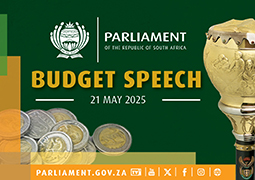
The Minister of Finance, Mr Enoch Godongwana, tabled the third 2025 National Budget before Parliament on 21 May 2025 in terms of Section 27 of the Public Finance Management Act, Act No. 1 of 1999 (PFMA) and Section 7 (1) of the Money Bills Amendment Procedure and Related Matters Act, Act No. 9 of 2009 (Money Bills Act).
The Fiscal Framework is for a specific financial year and gives effect to the national executive’s macro-economic policy. It includes a range of issues, such as estimates of all revenue (budgetary and extra-budgetary specified separately) expected to be raised during that financial year and forecasts of borrowing for that financial year.
The committees jointly received briefings from the Minister of Finance and the South African Revenue Service (SARS) Commissioner and received inputs from the Parliamentary Budget Office (PBO) and the Financial and Fiscal Commission (FFC).
In its submission, the PBO advocated for rigorous parliamentary oversight and evaluation of the 2025 budget’s projections and outlooks, especially considering global uncertainties and potential unintended consequences of tax increases.
In addition, the FFC called on the government to expedite its commitments in the 2024 Medium-Term Budget Policy Statement, particularly concerning managing the public-service wage bill through cost containment measures, including implementation of the early retirement programme with pension implications, to alleviate the significant spending pressures on the fiscus.
The committees held public hearings and 16 submissions were received from various stakeholders, including the South African Institute of Chartered Accountants, South African Breweries, the Congress of South African Trade Unions, the Alternative Information and Development Centre, the Budget Justice Coalition and the Institute for Economic Justice.
From the submissions received, the stakeholders welcomed the withdrawal of the VAT increase and additional allocations to SARS. The stakeholders, however, raised concerns about the proposed consumer price index adjustments to the fuel levy, no adjustment to personal income tax brackets, above inflation increases in excise duties, withdrawal of zero-rated food items, and failure by National Treasury to increase the Social Relief of Distress grant allocation and to consider the alternative revenue sources proposed.
They also called for improved accuracy in Treasury’s economic forecasting, clearer timelines for implementing social policy reforms and greater accountability for public spending. Civil society groups urged Parliament to consider the human rights implications of budget cuts and advocated for bold, growth-enhancing measures, including support for small businesses, youth employment and equitable tax reforms.
The committees acknowledged the difficult economic environment – marked by low growth, structural challenges and underperforming tax revenues – and expressed concern over high unemployment, currently at 32.9%, representing 8.2 million people. However, they welcomed the additional R4.59 billion allocated to public employment programmes for 2025/26 and urged National Treasury to monitor and report on progress, ensuring these initiatives deliver sustainable employment.
The committees also raised concerns about persistent high contingent liabilities linked to state-owned enterprises (SOEs), noting that if these materialise, they could jeopardise the country’s debt-to-GDP path. While government remains firm on not bailing out SOEs, the committees recognised their strategic economic role and recommended structural reforms.
The committees also recommended that National Treasury outline how the new public–private partnerships model will improve SOE effectiveness and alignment with policy goals. They also called for a strategy to support strong SOEs and stabilise struggling ones, in line with the National State Enterprises Bill before Parliament.
In the NCOP all nine provinces voted in favour of the adoption of the 2025 Fiscal Framework and Revenue Proposals while in the NA 2 members abstained, 88 voted against and 268 voted in favour.
With the approval of the Fiscal Framework and Revenue Proposals by both Houses of Parliament today, the relevant parliamentary committees will now proceed with the next phase of the budget process. This includes the consideration of the Division of Revenue Bill and the Appropriation Bill. The committees will conduct detailed analysis, hold consultations where necessary, and make recommendations for consideration and adoption by the respective sittings of the National Assembly and the National Council of Provinces.
To download the soundbite of:
- Chairperson of the Select Committee on Finance, Ms Sanny Ndhlovu click here: https://www.iono.fm/e/1565287
- Deputy Chairperson of the NCOP, Ms Les Govender click here: https://www.iono.fm/e/1565292
- Chairperson of the Standing Committee on Finance, Dr Mkhacani Maswanganyi click here: https://www.iono.fm/e/1565278
- House Chairperson: Committees, Oversight and ICT in the NA, Mr Cedric Frolick click here: https://www.iono.fm/e/1565314
ISSUED BY THE PARLIAMENT OF THE REPUBLIC OF SOUTH AFRICA
Enquiries: Moloto Mothapo
 Arrange a tour