


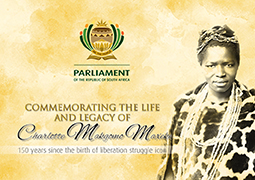
REMEMBERING CHARLOTTE MAXEKE: WOMEN’S STRUGGLE, WOMEN’S LEADERSHIP AND PARTICIPATION ACROSS ALL SECTORS OF SOCIETY
Chairperson of the National Council of Provinces
Speaker of the National Assembly
Deputy Speaker of the National Assembly
Speakers of Provincial Legislatures
House Chairpersons
Chief Whips
Members of Parliament and of Provincial Legislatures
Participants
Distinguished Guests
Ladies and Gentlemen
We have come together in this manner today, to pay homage and honour, one of the Greatest Leaders of our Liberation Movement. Today, We are Honouring, an Iconic Leader of the Oppressed and Dispossessed People of South Africa. A woman of Great Courage, Great Fortitude and A True Daughter of the Soil.
Mme Charlotte Makgomo Mannye Maxeke, has left an indelible mark in the History of our country’s Painful Past. She has Blazed an uncommon Trail, through Courage, Servanthood and a dedication to advance the liberation of our people.
Chairperson, Honourable Members and Distinguished Guests, the year 2021 marks exactly 150 years since the birth of our Gallant Warrior, Mme Charlotte Maxeke. This 150-Year Milestone, also comes at a time when the world is facing one of its most formidable Turning Points. We know that the COVID 19 Pandemic has negatively impacted the global economy, including that of our country. The ripple effect of this pandemic, has effectively exacerbated development challenges, particularly in emerging economies such as South Africa. It has resulted in rising levels of unemployment. It has deepened inequality and worsened of the state of our economy, which was already in a technical recession before the outbreak of the pandemic.
When we juxtapose the time during which Mme Charlotte Maxeke made her contribution to where we are today, we are reminded that she too, was faced with an uncommon enemy. Her era was characterised by the onslaught of colonialism, violent land dispossession, and the brute force of colonisation. As Voortrekkers moved away from the cape colony to escape to establish British rule, they fought seized and occupied land, while dispossessing Khoi, San and African Communities. This opened up the interior of South Africa to further colonial conquest This seizure of land, was not only violently executed, it changed the economic fate of Africans. This onslaught sought to subdue and conquer our indigenous ancestors.
When we draw parallels between these two historic era’s (Colonialism ad the era of the COVID Pandemic), it is evident that the era of colonial oppression and the COVID 19 Pandemic, represent moments of crisis, which can become, which also be recognised as strategic platforms, to redefine and set the country on a new development trajectory. It is also important that we remain fully aware, that this pandemic, has exacerbated pre-existing inequalities, which continue to disproportionately affect women and girl child in South Africa..
This pandemic is threatening to reverse the gains that we have made since the advent of our democracy, particularly those advanced through the gender discourse and women’s collective activism. Most Significantly, this pandemic also stands as a threat undermines the rightful place and status of women in South Africa. Gender Based Violence and Femicide has reached alarming levels, while the material conditions of poverty as experienced by women, continues to undermine their independence and status in society.
Now more than ever, these challenges require concerted and targeted action from the broader women’s empowerment network across the country. We must Develop the appropriate battle plan, to counter attack this pandemic, alongside the social and economic ills that it is currently breeding.
Charlotte Maxeke the Matriarch
As we think about the challenges that women are currently facing, we must do so in remembrance of Charlotte Maxeke, the Matriarch and Activist for Gender Rights. She challenged the status quo during a time when the Social, Political and Legislative Landscape, was defined by discriminatory norms and traditions.
During this time, patriarchy was rife and deeply entrenched. Furthermore, the brute force of Colonialism and Land Dispossessions, created an acrimonious atmosphere, where the Identity and voice of Africans was forcefully undermined and diminished. Additionally, African Norms of Patriarchy also denied Women the right to speak and be Heard. The stark reality was that women had no place in spaces of Leadership and Activism.
Despite these limiting beliefs, Mme Maxeke made a formidable contribution, towards shifting entrenched levels of patriarchy and racial segregation. She showed fortitude and courage by daring to challenge the socio-political system that she was born into.
In most of her undertakings, Maxeke played an important role in profiling the struggles of women.
Political Activism
Honorable Members and Distinguished Delegates
As we commemorate this important milestone in history today, it is important that we authentically tell the story of Charlotte Maxeke, in order to give true expression, to the contribution that she has made in our liberation movement.
Very often, the contribution and participation of women in the liberation movement, is often downplayed or minimized. Patriarchy often paints a distorted picture, of a Male Liberator, who Marched unaided and Uninspired by the Hand, Voice, Wisdom and Courage of women.
Today, we must commit to tell our daughters and grand-daughters these stories of heroism, of Women in Battle, in order to ignite another generation of gallant leaders to respond to the challenges of this epoch.
In 1912, Mme Maxeke attended the launch of the South African Native National Congress (SANNC), which later became the African National Congress, which took place in Bloemfontein.
Through her leadership, she activated the process to lobby for the admission of women to the organization, particularly at a time when the ANC only granted membership to men. She is also recognized as an important contributor in the literary foundation of the ANC in its early days.
As part of her important contribution, she authored many of the ANC’s earliest literature, influencing the posture of an emerging liberation movement at a defining moment of its foundation.
Advancing Gendered Representation
History also reminds us that the fight for the emancipation and empowerment of women, was very close to Mme Maxeke’s heart. She played a remarkable role in building confidence in many women of her time. She Co-founded the Bantu Women’s League of the SANNC in 1918, which later became known as the ANC Women’s League, which in itself was a decisive effort, to ensure that women’s participation in the liberation movement, is not stifled or undermined by patriarchal norms and traditions. She also Wrote in Xhosa on Women’s Social and Political Situation, which was a bold effort to begin to Advance the Cause of Gender Equality and the Status of Women in South Africa. History also reminds us that in most of her Undertakings, she played an important role in Profiling Women’s Struggles.
Honorable Members and Distinguished Guests,
1954 is remembered as a turning point in history, when thousands of women, across the racial spectrum, marched to the union buildings in protest against pass laws. We often do not go further back in history, to pay homage and acknowledge, that Mme Charlotte Maxeke, in her capacity as leader of the Bantu Women’s League, led a delegation of women to Prime Minister Louis Botha, in order to discuss the issue of passes for women.
These discussions resulted in Maxeke leading a March of 700 Women, in 1913, which is often unspoken of. This was a march against the Violent and Much-Feared Pass Laws, which were first introduced under colonial rule in 1779. Maxeke and 700 women Marched to the Bloemfontein City Council, where they burned their Passes. This moment signifies an important turning point in history, which sparked the will in women to organize themselves, standing in unity against an oppressive system.
The Cause of Women’s Enfranchisement had also been close to Maxeke’s heart, from the turn of the century. She hence advanced a concerted and united effort, in an effort to profile Women’s Struggles. This cause she advanced by addressing the organization for the voting rights of women, called the Women’s Reform Club in Pretoria.
Championing Workers Rights
She was also involved in protests on the Witwatersrand about Low Wages and Participated in the formation of the Industrial and Commercial Workers’ Union (ICU) in 1920. Recognizing the plight of Africans, who were severely affected by conditions of unemployment and poverty, she understood that unions represented an important bargaining mechanism, which could be used to advance and improve quality of life.
She also set up an employment agency for Africans in Johannesburg and was involved in multiracial movements.
Advancing Access to Education for Africans
It is also important to indicate that Charlotte Makgomo Mannye Maxeke, is the First Black South African Woman to Graduate with a University Degree. She graduated with a BSc from Wilberforce University, Ohio, USA in 1901.
Her passion for learning also led her to expand opportunities for Africans to receive a decent education. She therefore welcomed the call by the South African Ministry of Education, to testify before several government commissions in Johannesburg, on matters concerning African Education, which was also another pioneering achievement for an African of any gender.
Along with the AME Church’s Widow’s Mite Society, these two groups were responsible for funding and educating thousands of young Africans, many in the United States and Britain.
As we celebrate and commemorate the life and times of the “Mother of Black Freedom”, we must be reminded that We stand on the shoulders of giants some of whom have indeed, made superhuman efforts to improve the human condition. Many of the heroines of our liberation movement and its enduring trajectory, are the countless gallant women, whose stories are often not told by history, or acknowledged for their contribution.
So, as we honour this great leader today, we must continuously ask ourselves this poignant question: “How best can we honour the life of a leader of her calibre”
Chairperson
My departure point as we embark on a year-long commemorative trajectory, is that we must adopt a new culture and ideology which locates, at its centre, the creation of conditions that support the general upliftment of women, as equal players in our society:
Towards this:
- We need to strengthen the National Gender Machinery Structures throughout the country, since these structures continue to experience challenges which seem to hamper their effectiveness. This means that we continuously address issues relating to the lack of proper co-ordination, the lack of authority in terms of the powers vested in the structure particularly in relation to the Gender Focal Point.
- We need to ensure the accelerated implementation of the outcomes and recommendations of the Provincial Reviews of the 1994 Women’s Charter for Effective Equality, the 1995 Beijing Platform for Action, the 2030 Agenda for Sustainable Development, as well as ensuring that the implementation of policies and laws that have been enacted by our government since 1994 delivers the necessary impact on women’s quality of life
- We need to incorporate a gender perspective into the design, development, adoption and execution of all budgetary processes, as appropriated, in order to promote equitable, effective and suitable resource allocation.
- We need to establish adequate budget allocation and budget oversight processes, in order to support gender equality and develop programmes that enhance women’s empowerment.
- We must advocate for gender equality education in schools and call for the implementation of women’s rights and gender power relations in the school curricula.
- We need to ensure that municipal integrated development plans institutionalise gender planning by sector (e.g.water and sanitation, local economic development etc.) and include gender disaggregated performance indicators and targets; provide gender budgeting good practice guides and toolkits; and,
- We need to embark on gender sensitive public participation and consultation at local level.
- We must root out GBVF in every area and locality in our society. The battle must be intensified and taken to every battle ground where the lives of women are threatened, whether its in the home, the work place or any other platform
- We must also ensure that we actively advance the economic participation and status of women in the country
Chairperson
The task is formidable but necessary. We must unleash the dream of Charlotte Maxeke, of seeing her sisters free and asserting themselves as equal partners in the joyful feast of victory as a democratic, non-racial, non-sexist and prosperous South Africa.
Therefore, we must restore to man, his true image by making the reign of freedom prevail over differentiations imposed by nature. And by eliminating all systems of hypocrisy that still reinforce the shameless exploitation, abuse and violence against women.
For the coming months, In Honour of this Great Stalwart and Architect of Our Democracy, Parliament will educate and deepen Charlotte Maxeke’s value system.
In the true spirit of the NCOP mandate, we will continue to engage districts and localities across all provinces in the country, to advance the revolutionary morality, embodied by the values that shaped Charlotte Maxeke, whose legacy is bequeathed to us.
Throughout this legacy year, we must also take a moment and pay tribute to all other women heroines like Lilian Ngoyi, Helen Joseph, Sophia Williams-de Bruyn, Rahima Moosa, Madi Hall-Xuma, Dorothy Nyembe, Adelaide Tambo, Albertina Sisulu and Winnie Mandela, to mention a few.
Throughout this year we will seek to write a women activist history and in that history there will be scores of names not so familiar and those who ordinarily will never be mentioned.
Since all were part of the collective
We should keep their spirits alive by re-establishing a platform for women’s accelerated advancement in the 21st century.
Long Live the Spirit of Charlotte Maxeke, Long Live!!!! Malibongwe!!!!
Thank you
ISSUED BY PARLIAMENT OF THE REPUBLIC OF SOUTH AFRICA
 Arrange a tour