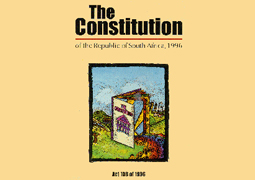
Parliament, Saturday, 9 May 2026 - The 8th of May marks 30 years to the day since the Constitutional Assembly adopted our final Constitution for a free and democratic South Africa.
Thirty years ago, in this Parliament, 490 men and women from across the political spectrum voted to adopt a Constitution that belonged to all South Africans - a Constitution that chose people over power.
The passing of the Constitution marked the birth of the South Africa for which we had long yearned. It signified the rise of the South Africa envisioned by the 3,000 people who gathered in Kliptown in 1955 to adopt the Freedom Charter — a vision of a South Africa that belongs to all who live in it, black and white.
The development of the Constitution was neither easy nor perfect; however, it was characterised by the will of the people, who were determined to formulate the legislative framework that would shape our future. It was a process defined by multiparty consensus rooted in deep public involvement.
Across all 19 committees that dealt with different aspects of the Constitution, including:
- Committee 1 – Character of the State
- Committee 2 – Separation of State Powers
- Committee 3 – The Three Spheres of Government
- Committee 4 – Fundamental Rights and the Application of the Bill of Rights
- Committee 5 – Judiciary and Legal System
I will not go through every committee; however, I wish to illustrate how labour-intensive and comprehensive the process was.
These committees received millions of submissions, despite there being no social media platforms at the time. For example:
- 1 million submissions were received on language issues
- 1 million submissions were received on the right to life
- 650,000 submissions were received in support of Parliament remaining in Cape Town
- 649,000 submissions were received opposing gambling in South Africa
Public participation was an essential ingredient in the development of our Constitution. Importantly, public comments were intended to assist the process, not to constrain or reverse it.
I say this because, when nearly 200,000 submissions were made in support of the death penalty, the Constitutional Assembly ruled that public input, while important, could not be the sole determining factor to the exclusion of other constitutional considerations.
As I reflect on this brief history of constitutional development, it speaks directly to one of the critical functions of Parliament - law-making underpinned by meaningful public participation.
Public participation has increasingly become a matter of focus in the work of Parliament in recent years. While public involvement is essential, it is important to recognise that it is not the only factor, but rather one of several important elements that define a fair and transparent process.
As we draw lessons from the Constitutional Assembly’s consideration of submissions on the death penalty, we too must weigh public comments carefully against the broader interests of society and the constitutional imperative to uphold human dignity and the sanctity of life.
Another important feature of the Constitutional Assembly was the vibrant and effective involvement of young people. Youth were central to the process of developing the Constitution. They carried the hope that a new South Africa was being born - one filled with opportunity and the promise of a better life for all.
These are the young people we need today to reignite the spark of hope, and to invigorate the spirit of unity and active citizenship.
Women also played a critical role in securing the equality clause in the final Constitution. The Women’s Charter for Effective Equality was a landmark achievement, bringing together women from diverse backgrounds to ensure that equality for women in all spheres - legal, political, social and economic - would be safeguarded at the dawn of democracy.
Their participation helped shape the non-sexist South Africa we enjoy today.
Over the past 30 years, we have used the Constitution as the supreme law guiding us in building a state of which we can all be proud. We have established an independent judiciary and developed a rich body of constitutional jurisprudence. We have built government structures across all three spheres, as envisaged in the Constitution.
Our Parliament and provincial legislatures continue to hold the executive accountable, make laws, and advance international parliamentary diplomacy. Our constitutional institutions are playing their part as moral compasses that help ensure we build an ethical, capable and functioning state.
We should regard this as the first phase of our participatory democracy.
The key task that lies ahead, in the second phase of our constitutional democracy, is how we use the established state structures and constitutional framework to address the intensifying socio-economic challenges of unemployment, inequality and poverty.
To achieve this, we must invest in human capital and ethical leadership that will steer these state institutions and legislative frameworks - developed over the past 30 years - to ensure that they respond effectively to the needs of the people and the interests of the country.
To me, that is the road ahead. It requires me, you, and every South African to pull in the same direction and to build upon the state we have created in pursuit of a better life for all.
The next 30 years will test whether we have the courage to live by the principles and values upon which we built our democratic state.
To our social partners: thank you for 30 years of helping to make the Constitution real and meaningful in the lived experience of our people.
To the people of South Africa: this Constitution is yours. Read it. Use it. Defend it.
ISSUED BY THE PARLIAMENT OF THE REPUBLIC OF SOUTH AFRICA
Enquiries: Moloto Mothapo, Parliament Spokesperson
 Arrange a tour