



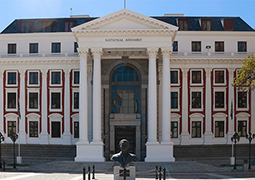
Parliament, Friday, 1 November 2024 – During its meeting last night, the National Assembly Rules Committee adopted several new rules and guidelines aimed at enabling the 7th democratic Parliament to perform its duties more effectively.
Section 57 of the Constitution provides that the National Assembly may make rules and orders to regulate its business with due regard to representative and participatory democracy, accountability, transparency, and public involvement. In terms of National Assembly Rule 193, the Rules Committee is mandated to develop and formulate proposals concerning the exclusive business of the Assembly in respect of its proceedings, procedures, rules, orders, and practices.
The Rules Committee agreed to proposals from the Subcommittee on the Review of Assembly Rules, which include proposals on motions without notice, closing doors during a division, extending the period for any independent panel set up in terms of section 89 of the Constitution to conclude its work, and directives for supplementing the National Assembly’s membership lists.
The Rules Committee also agreed to send the following matters back to the Subcommittee for further consideration:
(1) The development of proposals for interpellations as part of the questions procedure.
(2) The development of proposals for a dedicated oversight committee on the Presidency; and
(3) The use of certain terms and definitions used in the rules.
Oversight over the Presidency
The National Assembly has various ways of overseeing and holding the executive to account. These include questions to the president, the deputy president, and the ministers, as well as portfolio and standing committees that oversee the respective government departments.
Following much deliberation, the committee decided, through a vote, to mandate the Subcommittee to process the establishment of an oversight committee on the Presidency. The Subcommittee will now consider the modalities of this committee and report back to the Rules Committee.
Improvements to Question Time
The rules permit members to pose both oral and written questions to the executive. Conversely, the executive is required to provide Parliament with complete and regular reports on matters under its control. On 26 June this year, the Rules Committee discussed the sequence of questions, the number of questions taken during a question time, the option of extending the time allocated, and concerns about the nature of ministerial replies.
In deliberating on these procedures, the committee voted in favour of re-introducing interpellations to improve the engagement with ministers. The committee nevertheless resolved to refer the relevant procedures to the Subcommittee. The Subcommittee was also asked to explore the possibility of a mechanism for short-notice interpellations in cases where it was apparent that a minister was unprepared to answer an ordinary question.
Executive Assurances and Petitions
Presently, the Assembly does not have specific instruments to monitor undertakings and promises made by members of the executive from the floor of the House. Moreover, while portfolio and standing committees already process public petitions, there have been concerns that petitions have not always been considered consistently. To address these challenges, the Rules Committee agreed to establish a special committee to follow up on government undertakings and process petitions.
The new rules adopted during last night’s meeting will now have to be formally adopted by the full sitting of the House before they are implemented.
ISSUED BY THE PARLIAMENT OF THE REPUBLIC OF SOUTH AFRICA
Enquiries: Moloto Mothapo
 Arrange a tour