



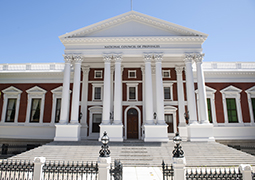
The Economic Freedom Fighters (EFF) recently sponsored a debate in the National Council of Provinces (NCOP) titled “Debate on rural infrastructure deterioration: A debate on municipal fund withholding in terms of section 216(2) of the Constitution”.
Ms Mandisa Makesini, an EFF permanent delegate representing the Free State province, was concerned that applying this section of the Constitution – which governs instances in which the National Treasury withholds funds from municipalities that fail comply with financial management requirements – has a direct impact on infrastructure development in rural municipalities.
While this section is applied to ensure transparency, accountability and proper financial management at an institutional level, the immediate consequence is the disruption of service delivery to citizens. “Infrastructure projects are halted and service delivery programmes are delayed and those municipalities that are already under strain are further constrained,” she told the hybrid sitting of the NCOP.
Ms Makesini believes the practical implication of invoking section 216 (2) in rural municipalities must be understood within the broader context of inequality and uneven development in South Africa.
“Section 216 (2) has direct and disproportionate impact on rural communities and when such funds are withheld infrastructure projects stall, maintenance of water and sanitation systems is delayed, the application of this section at local level expose a structural contradiction as municipalities that are already failing are further deprived of resources,” she said.
The EFF warned that withholding of the funds, instead of stabilising governance, may deepen institutional failure and accelerate infrastructure collapse in these municipalities. “In an attempt to discipline non-complying municipalities, the state may entrench infrastructure deterioration in rural areas,” she said.
Debating on behalf of the Democratic Alliance, Mr Paul Swart, a permanent delegate from the Western Cape, defended section 216 (2) and said it was not a punitive measure but a response to failed governance.
“Funds are withheld under section 216 of the Constitution when municipalities fail to comply with financial management rules. National Treasury does not punish communities, it responds to failed governance. We cannot continue to put money in municipalities where procurement rules are ignored, tenders are manipulated, infrastructure budgets are treated like personal bank accounts while services go undelivered. Unless we fix governance, infrastructure will continue to collapse and rural communities will continue to suffer,” he said.
Another NCOP delegate who supported the application of section 216 was Ms Regina Molokomme, ANC NCOP permanent delegate from Limpopo, who emphasised that the application of this clause was not a punitive measure but an intervention to correct wrong-doing.
“The true spirit of this clause is not to punish our people by withholding their equitable shares, but its intention is to protect the public purse from serious or persistent material breaches of financial management, it is meant to stop continuous financial rot. The impediment we face is that section 216 is often treated as a last resort. By the time Treasury stops the funds, the municipality is already in an advanced state of collapse,” she said.
Ms Molokomme suggested that if a rural municipality fails to submit an audit-ready financial statement for two consecutive cycles, section 216 must not just stop the money, it should automatically trigger a mandatory diagnosis. “Section 216 must be catalysed for intervention not just an act of financial garnishing. To fix local government, we must empower our district municipalities. They are a strategic hub of our rural economy under the District Development Model,” Ms Molokomme said.
Mr Sibongiseni Majola, a permanent delegate of KwaZulu-Natal and uMkhonto weSizwe Party representative, believes that while section 216 (2) looks good on paper, its intervention has not produced the expected results. “Section 216(2), which empowers National Treasury to withhold funds where there is financial mismanagement or misconduct, is one of the strongest tools available to enforce fiscal discipline, but in practice it has become something else.
“It is a procedural response to a systematic failure rather than a tool that produces real accountability. When funds are withheld, a municipality does not suddenly become clean, corruption doesn’t suddenly stop, officials do not suddenly face consequences – instead, something more dangerous happens: infrastructure projects stall, maintenance budget shrink, water system deteriorate, roads become impassable,” Mr Majola said.
Also, participating in the debate, the Minister of Land Reform and Rural Development Mr Mzwanele Nyhontso joined the chorus of those who support the application of section 216. “Enforcing fiscal discipline through section 216 is necessary mechanism to enforce compliance with the Municipal Finance Management Act, ensure adoption of funded budgets and strengthen accountability in municipal financial management.
However, the current application introduces critical policy contradiction. While it enforces compliance, it simultaneously risks by disrupting service delivery, deepening infrastructure collapse and undermining constitutional rights in already vulnerable communities – enforcement without a parallel service delivery continuity mechanism. Fiscal enforcement alone is not sufficient,” the Minister said.
Sakhile Mokoena
26 March 2026
 Arrange a tour