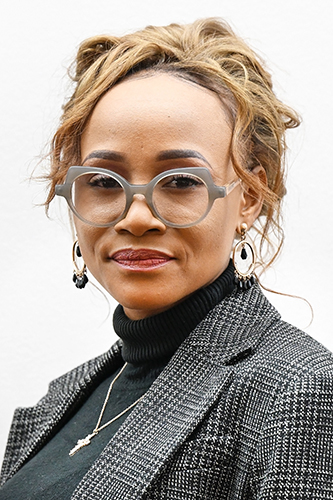



Seventy years after women marched against pass laws, the test of freedom is no longer only who occupies power, but whether the state responds when women are denied access to water, safety, and deprived of their dignity, declared the Commissioner of the South African Human Rights Commission, Ms Nomahlubi Khwinana.
Reflecting on this gender deficit, she pointed out that the iconic statue of Frances Baard stands in Kimberley as a representation of where the collective memory of the past and the present-day failure meet. “It honours one of the women who helped organise the 1956 Women’s March, yet it also stands inside the Sol Plaatjie Local Municipality, a place recently named in a South African Human Rights Commission inquiry as one of the municipalities that presides over collapsing local services in the Northern Cape.”
She went on to outline the commission’s report on service delivery challenges that exacerbate the plight of women in this municipality. “The Commission’s report placed sewage spillages, sanitation failures and wider municipal dysfunction at the centre of a larger question: what does freedom mean when a woman cannot trust the tap in her home, the toilet at her school, or the council office meant to respond to their plight?”
She said she was putting a spotlight on these short comings because “when services fail, women carry the cost”.
So insightful was this inquiry, she said, it drew on thirty-five complaints from across the province. And it found that more than seven in ten Northern Cape municipalities may need intervention. It documented poor financial governance, skills shortages, weak revenue bases.
In Ms Khwinana’s view, these are not mere administrative details, they are problems that are borne mainly by women headed households. “They shape the daily life of families in this province, especially women because they are the ones who are responsible for children, elders and households.” She then enumerated the effect of this failure in municipal governance. “The failure of local government is often experienced first as time lost, money spent, safety compromised and dignity eroded.”
The Gap Between Reports and Remedies
South Africa is not short of legislation and policy framework to ameliorate its socio-economic challenge, Ms Khwinana said. But what is most lacking is acccountability. “Reports are written, tabled and welcomed. The harder test is substantive accountability and whether recommendations are funded, implemented and tracked to ensure they meet their desired effects.”
This disjuncture matters most to indigent women living in rural areas who are often deprived of basic services because of their geographic location. “A rural woman without transport, a nearby clinic or a functioning municipal office experiences government failure differently from someone in a town with options. A provincial report that does not see those differences risks missing the people most in need of protection.”
These are not the conditions that women’s agitations of 1954 and 1956 envisaged in a democratic dispensation. “This cannot be the freedom Baard and her generation imagined. They did not organise women door to door so future leaders could occupy comfortable seats while departments failed the very people those seats exist to serve.” She invoked Albertina Sisulu’s words to underscore the fact that it’s only women who can free themselves from their lot.
The Cost of In Action
Parliament’s Portfolio Committee on Police has already warned that action plans are not enough when police stations fail to comply with the Domestic Violence Act, when victims are turned away and protection orders are not delivered on time, Ms Khwinana observed.
Not to mention the DNA backlogs which add another delay, holding up evidence that GBVF prosecutions often depend on. “The lack of consequence management is the root cause of this inability to change course.”
However, there is evidence that the pattern can be broken. “In Limpopo, a hundred-day challenge involving the National Prosecuting Authority, SAPS, Justice and Legal Aid sharply reduced GBVF backlogs in participating courts and improved domestic-violence finalisation rates.” This goes to show that a focused approach and time-bound cooperation can produce measurable results, Ms Khwinana elaborated.
She went on to site standards set by the Constitutional Court in the Grootboom judgment. It states that “those whose needs are most urgent must not be ignored”.
Therefore, remedies to alleviate the plight of women are not mysterious. Similarly, she said, “Northern Cape municipal interventions should be implemented under clear timelines and tracked publicly.” Also, she added, “forensic laboratories need funded capacity, so DNA delays do not weaken GBVF cases. The Limpopo backlog model should be adapted by other provinces.”
Gender inequality remains an unfinished promise of 1956. And their clarion call “Wathint’ Abafazi, Wathint’ Imbokodo” remains a tribute to their cause and was relevant then as is today.
Until all women’s rights are realised, the commemoration of these women movements will remain an ideal. “Women should not be content with how solemnly the country remembers their march, but how it dedicates its resources and capabilities to address their historical yearn for gender equality and equity.”
Abel Mputing
14 August 2026
 Arrange a tour