


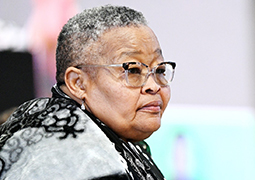
In her address, the Chairperson of the Joint Standing Committee on Intelligence in the South African Parliament and Chairperson of the Review of the Women’s Charter, Ms Silvia Izaks, outlined the historic genesis of women’s formations that advanced the struggle for gender equality.
She recalled that in 1956, more than 20 000 women stood in silence outside the Union Buildings, holding petitions and the weight of a country’s unfinished promise in their hands. For 30 minutes, they said nothing. Yet their silence became one of the loudest demands in South Africa’s history.
Seventy years later, that silence still echoes, she opined. She urged women to utilise the memory of the 1956 Women’s March to ask a question that has followed South Africa through democracy: has the promise made to women been properly funded, enforced and felt in their daily lives?
Her message traced the thread of the struggle for gender equality from the 1954 Women’s Charter and the Women’s March of 1956 to the 1994 Women’s Charter for Effective Equality, and finally to the 2021 Women’s Charter for Accelerated Development. In her view, together, these moments tell the story of a country that has repeatedly written women’s equality into its political imagination but, regrettably, has struggled to turn that vision into a lived reality.
The first promise
She recalled that the first of those promises was made in Johannesburg on 17 April 1954, when the Federation of South African Women, known as FEDSAW, was established. At its inaugural conference, she continued, women from different racial, class and political backgrounds gathered as a national body at a time when apartheid laws were tightening their grip on family life, movement and work.
“Pass laws for women were looming. Domestic workers were vulnerable to raids. Children and families were being uprooted by a state that sought to control every part of Black life.” In response, she said, FEDSAW drafted the Women’s Charter – not merely as a complaint against oppression, but as a vision for a free society.
A silence that still speaks
Two years later, in 1956, more than 20 000 women marched to the Union Buildings, carrying the 1954 Women’s Charter in their hands and in their hearts. They marched as groups, led by four representatives: Lilian Ngoyi, Helen Joseph, Rahima Moosa and Sophia Williams -De Bruyn. “At the Union Building they stood in 30 minutes of silence, which was a deliberate tactic of dignity and discipline. They left 14 000 petitions at Prime Minister JG Strijdom’s office door, since he did not want to see them.”
The 1956 March gave birth to a tradition of women’s resistance. It fed into the broader struggle and contributed to legal victories in 1994. “Because of the lineage of 1956, the 1994 Women’s Charter and the Constitution included the equality clause, maternity rights and the right to own property.”
Women’s Charter for Effective Equality
After CODESA and the unbanning of political parties, women said we are not going into a new South Africa with old inequalities. As a result, Ms Izaks said, “Groups like Rape Crisis, Black Sash, rural women’s forum and trade unions came together and the goal of women coming together was clear: don’t let the Constitution be written without us.”
This led to the adoption of the final Women’s Charter for Effective Equality on 17 April 1994 at a National Women’s Conference in Johannesburg. “The Charter then become the blueprint for gender equality and led to the creation of the Commission for Gender Equality, the office of the status of Women in the Presidency, and Gender Focal points in departments,” Ms Izaks continued.
The 2021 Women’s Charter for Accelerated Development
2019 marked 25 years since the adoption of the 1994 Women’s Charter for Effective Equality. During commemorative discussions held at the 2019 Women’s Parliament, South African women across all nine provinces and the three spheres of government unanimously requested Parliament to review the 1994 Women’s Charter.
“One of the key objectives of the review, was to take stock of the achievements garnered since 1994 and to assess the systematic weaknesses that continue to impede the advancement and realization of the gender equality in South Africa.”
Parliament successfully completed its nationwide 25-year review of the 1994 Women’s Charter. Throughout the country-wide review sessions, Parliament gathered valuable information and findings. Some of the findings emanating from the review process included the following:
Despite the plethora of policy and legislative instruments enacted since the advent of democracy in 1994, women in South Africa continue to bear the brunt of high levels of poverty, inequality, economic exclusion, unemployment, gender-based violence and femicide.
Government’s existing gender-responsive budgeting mechanisms are fragmented and lack coherence and broad-based political support. Furthermore, the gender-responsive planning, budgeting, monitoring and evaluation frameworks are non-binding, with no mandatory provisions for adherence.
No province was found to have an articulated theory of change embedded in women’s empowerment principles and gender equality prescripts.
There are no mechanisms in place to institutionalise gender transformation and mainstreaming through the Provincial Growth and Development Strategies of the provinces and the Integrated Development Plans and Local Economic Development Plans. Currently, there is no province with a PGDS underpinned by gender-responsive planning, budgeting, monitoring and evaluation, and gender auditing.
Government does not have a mandatory and institutionalised gender-responsive budgeting mechanism, which enables a gender-inculcated perspective in the consideration of the budget.
The 2021 Women’s Charter for Accelerated Development was not just a new document, but a diagnosis.
What the review found
The review highlighted three central challenges:
Good laws, weak delivery.
Fragmented efforts and working in silos.
Budgets that are gender blind.
What now needs to happen
What now needs to happen is to forge a common vision and build a comprehensive social compact with a clear programme of action to realise the inspiration of the Women’s Charter, Ms Izaks reflected.
“We will need to push for a resolution to review the non-binding nature of the gender responsive budgeting, planning, monitoring and evaluation. The gender responsive budgeting cannot be a nice-to-have in a Treasury circular. We call for it to be legislated and binding.”
Further, she stated, we call for the strengthening of the National Gender Policy Framework and it must be costed and be aligned to the NDP.
Abel Mputing
13 August 2026
 Arrange a tour