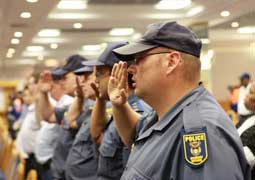
During its engagement on the South African Police Service (SAPS) budget and annual performance plan (APP) for 2026/27, the Select Committee on Security and Justice welcomed the move to re-vet SAPS officials and conduct lifestyle audits, which is aimed at restoring accountability and morale in the service.
Acting National Police Commissioner Lt Gen Puleng Dimpane confirmed on Wednesday that the State Security Agency (SSA) is currently conducting lifestyle audits of lieutenant-generals, with plans to expand the process to major-generals. The initiative forms part of a broader “reset agenda” intended to restore credibility and public trust in a scandal-hit SAPS.
The lifestyles of South Africa’s highest-ranking police officials are now under close scrutiny, not only to uncover corruption, but to rebuild confidence in the institution following damaging allegations emerging from the Madlanga Commission of Inquiry and Parliament’s Ad Hoc Committee investigations.
Ms Jane Mananiso, Chairperson of the committee, said in her opening address that SAPS was facing enormous challenges amid revelations emerging from the commission and parliamentary processes. “This will require SAPS to realign and reposition itself to ensure that police officers who remain are committed and capable of fighting crime,” she said.
“It has exposed that the ethics within the police service have been eroded. Whether senior, junior or in the middle, everybody now could be called to appear. We applaud you for taking training and development seriously as one of the key interventions to restore morality within the police service.”
Lt Gen Dimpane told Members of Parliament that all lieutenant-generals were currently undergoing lifestyle audits conducted by the SSA, describing this as the first phase of a broader vetting process.
Committee member Mr Ofentse Mokae said Parliament should eventually be briefed on the findings and trends emerging from the audits. “What is happening in the country has laid bare some of the issues that have infiltrated our security cluster, in particular the SAPS,” he said.
Another committee member, Mr Sifiso Zulu, questioned how many senior SAPS officials had undergone lifestyle audits, how many had been referred for further investigation, and whether any cases had resulted in suspensions, disciplinary action or criminal prosecution.
Responding to members’ questions, Lt Gen Dimpane said SAPS is determined to rebuild public confidence. She noted that updates would be provided, where possible, on officials flagged during the process and the action taken against them. “Indeed, this is what the reset agenda is all about,” she said. “It starts with accountability.”
The SAPS identified the fight against corruption, including the implementation of Madlanga Commission recommendations, as one of its top priorities for the 2026/27 financial year.
The presentation further highlighted tighter controls within the Central Firearms Registry (CFR), an area previously linked to corruption and irregular firearm licensing processes. SAPS said irregular firearm licence applications were now subjected to ad hoc audits, while dedicated officials were handling corruption-related matters.
The committee heard that these measures have already led to active cases, suspensions and strengthened evidence-based oversight, ensuring accountability and early detection of misconduct.
The SAPS also outlined plans to modernise its information and communications technology systems through the rollout of approximately 12 600 desktops, 4 650 laptops and 3 900 scanners to police stations across the country. Radio communication systems are also expected to be upgraded.
The committee heard that SAPS is pursuing several interventions aimed at rebuilding public trust and modernising policing. In addition, SAPS plans to introduce body-worn cameras and dashboard cameras to strengthen accountability and improve evidence collection. The rollout includes approximately 450 body-worn cameras at high-priority stations and districts, as well as dashboard cameras at 100 operational sites, including Public Order Policing and Highway Patrol units. Ms Mananiso said it is important that the committee are kept abreast of this, to the extent of showing the body-worn cameras to the committee.
However, Lt Gen Dimpane acknowledged delays in implementing the body-camera project, citing procurement challenges involving the State Information Technology Agency.
The meeting also highlighted concerns around the ageing SAPS vehicle fleet. The police service currently operates 42 186 vehicles, many of which are under severe operational pressure due to high mileage, costly repairs and ageing infrastructure. Committee member Mr Mzamo Billy raised the issue of the maintenance of police vehicles, saying that a police station in the west of Durban has six vehicles, which are new, but not working because they have no tyres.
According to SAPS, approximately 7 500 vehicles are undergoing repairs or maintenance at any given time, placing significant strain on operational readiness and frontline policing capacity.
Ms Mananiso said the committee will continue to monitor the SAPS to ensure they provide the services that South Africans deserve.
Rajaa Azzakani
22 May 2026
 Arrange a tour