


The Dangerous Weapons Act No. 15 of 2013 has now become law. Prior to the introduction of this legislation, there was a lack of uniformity in legislation dealing with dangerous weapons. Former apartheid states had their own laws on dangerous weapons and there were five different pieces of legislation that dealt with dangerous weapons.
The Secretary for the Police Service in charge of the Civilian Secretariat for Police, Ms Jenni Irish-Qhobosheane, told MPs that the Bill was an attempt to rationalise these various pieces of legislation. An extensive public participation process had been conducted by the Secretariat of Police to get all possible views pertaining to the legislation. The public participation processes elicited 2 300 comments in which people expressed their concern about the laws governing the dangerous weapons that were used in the large number of violent crimes in the country. Besides repealing all other Acts that deal with the legislation of dangerous weapons, the Bill will give powers to the police to arrest and disarm those who carry dangerous weapons "under suspicious circumstances".
Presentations made at the parliamentary public hearings raised fears of how the legislation would take away citizens' rights to defend themselves by narrowing the definition of a dangerous weapon. When dealing with the public, the Committee reiterated the fact that in its passing of the Bill, the Committee had ensured that the rights of citizens to defend themselves were not taken away by the Bill.
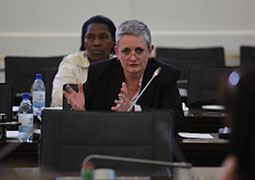
"The Bill will not in any way disarm citizens who have (and carry) weapons for self-defence," said Committee chairperson Ms Annelize van Wyk.
Carrying weapons at service delivery protests is currently covered by the Illegal Gatherings Act. The Bill will strengthen that Act by not only outlawing the carrying of firearms during gatherings, but any objects that can be used as weapons during scuffles. The Act has also taken into consideration concerns raised by the public during the public hearings that it should not interfere with the carrying of religious or traditional weapons during traditional or religious gatherings and provides for the legitimate collection and display of weapons.
Among concerns raised by the public was the fact that the Bill did not seek to protect members of society against the country's frequent violent crimes. The South African Hunters and Game Conservation Association raised concerns that the Bill sought the power to actively control the possession of dangerous weapons and speculated that perhaps the South African Police Service (SAPS) did not have sufficient capacity to regulate dangerous weapons.
The Legal Resources Centre raised concerns that bottles and cups were not considered dangerous weapons, even though they endangered victims of domestic violence. To this end, it suggested that a broader definition in the Act should lead to the prosecution of more cases in which normally benign objects were used for violent ends. "The definition should be broadened further to include any object made or modified to kill or cause harm or any object actually used for that purpose," said Ms Charlene May, an attorney from the Legal Resource Centre.
Dr Johan Burger of the Institute for Security Studies (ISS) said that, in general, the ISS did not have a problem with the Act. "The Act came about for two reasons. One was to consolidate all the different laws of previous homelands, each of which had its own law. This was becoming problematic and the police and courts needed clarity." The second reason was to criminalise the use of fake weapons, such as toy guns. "This part of the law says reasonable intent should have been shown to use this weapon to commit a crime," he said.
Dr Burger pointed to the challenge with the phrase "reasonable intent" and the difficulties raised about how police officers would assess if reasonable intent was shown. "Training is the only solution to this challenge for officers to be able to distinguish what exactly 'reasonable intent' is. They should know the boundaries in order not to cross them."
The Dangerous Weapons Bill was adopted by the Select Committee on Security and Constitutional Development on 12 June 2013. No amendments were made to the Bill by the National Assembly, and it was approved by the National Council of Provinces on 18 June. It was signed into law in August by President Jacob Zuma.
 Arrange a tour