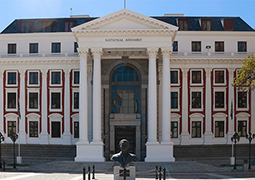
The Freedom Day debate in Parliament recently was held under the theme: United in our resilience to advance social and economic justice and to defend South Africa’s democratic order and sovereignty.
Opening the debate, Ms Sthembile Hlongo of the ANC, declared: “I owed my voice, freedom and place in this Parliament to the sacrifices of those who came before me. I stand before you as a child of our democracy, nurtured by the hope that South Africa belongs to all who live in it.”
In essence, she declared, 27 April 1994, is a day that turned the promise of Freedom Charter into a lived reality. Sadly, there are those present in this house who want to “resurrect the architecture of colonialism and apartheid. Who willfully ignore the bloodshed and sacrifices that won us our freedom.” As young South Africans, she said: “We stand on the shoulders of giants and pioneers that paved a way for the successive success of young black South Africans in various facets of life. Let it be known; we would not surrender our hard-won democracy and sovereignty to the forces of imperialism.”
What does this day mean to millions who still live in shacks, to the unemployed youth, and to the landless communities, asked Mr Sanele Mwali for the uMkhonto WeSizwe Party. We don’t commemorate this day with a celebration, he said, “We mark it with defiance because true freedom has not yet been attained. It follows that the fight for freedom is far from over.”
He added, “We were promised land, we instead got title deeds to township houses, we were promised the distribution of wealth, instead we got tenderpreneurs. We were promised dignity, but many live without it.”
As we commemorate Freedom Day, said Mr Bonginkosi Madikizela (DA), we must look at the rights and liberties both realised and unrealised because millions of people are still trapped by poverty, inequality, unemployment and crime. He is of the view that addressing these challenges will not come from old rhetorical slogans and policies. Instead, we need decisive leadership, “to implement economic reforms to urgently deliver and grow our economy”, which his party believes can only be delivered through the Government of National Unity.
Are we indeed free or are we being fed lies and a sense of false hope, asked Mr Nthako Matiase (EFF). Political freedom is meaningless without economic freedom. “As long as land has not been expropriated and returned to its rightful owners, as long as the mines and strategic economic sectors remained untransformed, there’s no freedom,” he said.
The critical question to be asked is: do South Africans feel free at all, according to Mr Nhlanhla Hadebe (IFP). “The enduring legacies of apartheid are still evident today. They manifest themselves in poverty, underdevelopment, crime, gender inequality, which erode the hope of a better future for our children.” As such, freedom is a shared project that we must nurture, defend and grow together to ensure it is shared with all, he noted.
This debate is supposed to bring us closer together as a nation, but has instead driven us apart, said Dr Petrus Mulder (FF+). Despite all that has been said, corruption and failed economic policies of government have exacerbated the economic status of our country. “IMF has projected that 44 African countries will witness economic growth; South Africa is none of them.” The economy is the most pressing problem facing South Africa, he claimed, saying that in 1994, South Africa had the strongest and biggest economy on the continent, but not anymore.
Has freedom come to South Africans, asked Mr Alan Beesley (Action SA) rhetorically. “With eight million unemployed South Africans and 60% of unemployed youth, freedom has not come to all South Africans.” He continued: “With many South Africans having limited access to basic services, quality education, health care, housing, social security, the answer is that freedom has not come to all South Africans.”
There’s nothing to celebrate because our country is regressing rather than progressing, said Rev Kenneth Meshoe (ACDP). “Many feel that there’s nothing to celebrate because the cost of living in South Africa is skyrocketing and, for many, life is difficult to bear. While on the other hand, the poor and indigent are frustrated by poor service delivery that they are entitled to by law.”
Abel Mputing
8 May 2025
 Arrange a tour