


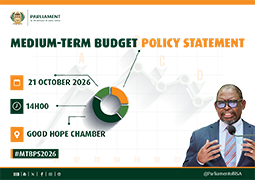
Following the tabling of the Medium-Term Budget Policy Statement (MTBPS), the Standing Committee on Appropriations invited the Parliamentary Budget Office (PBO) to provide an analysis of the 2026 Division of Revenue Amendment Bill, the Adjustment Appropriation Bill and the Special Appropriations Bill.
MTBPS provides an adjusted fiscal framework that stipulates the total projected revenue, provides economic growth estimates and debt caps, and outlines how funds will be adjusted and split across national, provincial, and local spheres of government.
The MTBPS also sets into motion the parliamentary appropriations cycle, an ongoing process through parliament scrutinises, debates, amends and passes legislation to authorise government spending from the national revenue fund.
At the meeting’s start, the Chairperson of the Standing Committee, Mr Mmusi Maimane, clarified that the committee was primarily interested in how the South African fiscus being used to advance issues of security, health care, education and economic opportunities, which are guaranteed in South Africa’s Constitution.
PBO’s presentation reported that the budget was adjusted by R10.6 billion, coupled with R6.1 billion of unspent funds. While the direct charge against the revenue fund amounted to R16.87 billion. The highest contributor to this was debt service costs, which now amount to R9 billion, an increase compared to the R4.8 billion government paid in 2025 to service debt.
More alarmingly, the PBO reported that unspent and roll-over funds, most of which was moved from social protection to early retirement packages and other operational requirements. Due to growing budgetary demands and stagnant GDP, the National Treasury has resolved to arrest debt and government expenditure and push for fiscal anchors that contribute to an increase in its primary surplus.
Many committee members criticised diminish government expenditure on social development in favour of early retirement funding in the face of staff shortages in the public healthcare sector, declining expenditure on child grants and school infrastructure, and the rising demand for housing.
Mr Sanele Mwali of the Umkhonto weSizwe Party put on record that his party rejects the logic of an adjusted budget that promotes austerity. He cautioned that reducing government debt must not come at the expense of social protection. He added that paying public servants to retire early should not be happening at a time that frontline service posts in the healthcare and education sectors remain unfilled.
Ms Olga Seate, who represents the African National Congress, asked what departmental non-expenditure says about the departments’ capacity to deliver on their service delivery mandates.
Regarding the proposal in the MTBPS to merge provincial grants that have concurrent service delivery responsibilities or mandates, Mr Michael Segede (ANC) asked is there is a capacity intervention strategy to support the proposal.
Mr Andrew Bateman of the Democratic Alliance asked if recurring budget shortfalls are politically motivated.
Dr Maimane asked the PBO for guidance on the budgetary trade-offs the government should pursue in the face a budget shortfalls. Should the government try to stabilise debt; should it borrow to fund economic growth or to service debt, he asked. He also enquired about the existence of useful interventions to alleviate youth unemployment, apart from Presidential youth employment programmes.
In response to these questions and the others raised by other committee members, the Acting Director of PBO, Ms Nelia Orlandi, stated that the shifting of funds from social protection to other areas would impact negatively on child support grants and other government welfare services.
On unspent and roll-over funds in provinces, the PBO welcomed the merger of grants with concurrent responsibilities. However, Ms Orlandi urged the National Treasury to assist provinces in improving the effective disbursement of these grants.
On the National Treasury’s primary surplus target, PBO economic analyst Ms Kagiso Mamabolo cautioned it should not be achieved at the expense of social development priorities. She explained this has contributed to a decline in funds allocated to hiring primary school teachers over consecutive financial years.
PBO public finance analyst Ms Sibusisiwe Sibeko voice her concern that the goal of R139 billion in primary surplus has not been costed against other government priority expenditures. This could have negative socio-economic implications in the long run, she said.
On the question of women and youth unemployment, Ms Sibeko welcomed the public sector’s role in creating a female black middle class. However, she observed that the government’s youth employment interventions are mostly temporary in nature and do not offer real employment opportunities.
On balancing government’s funding priorities, PBO Deputy Director Dr Seeraj Mohamed observed that the current fiscal framework focuses more on the supply rather than the demand side of South Africa’s socio-economic conditions. An equilibrium is needed to balance these priorities, he suggested.
Abel Mputing
18 November 2026
 Arrange a tour
