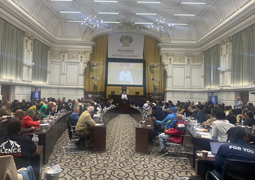
As Parliament opens a wider inquiry into gang-related violence, residents, police, soldiers and researchers are being asked to confront a difficult question: what drives this ecosystem of violence, and how can it be eradicated?
These were the remarks of the Chairperson of the Portfolio Committee on Police, Mr Ian Cameron, in his opening address at the Parliamentary Summit on Gang-Related Violence held at Parliament today.
Mr Cameron stressed that gang violence is not an abstract phenomenon. It is a reality that shapes the daily lives of affected communities. “Gang violence is not an abstract policy problem. It decides whether a child can walk to school, whether a mother can send her children to the shop, which streets an ambulance may enter, whether a witness will speak, and whether a family sleeps in a bed or on the floor when the shooting starts.”
He said the summit marked the beginning of Parliament’s commitment to a prolonged, nationwide inquiry into the causes and effects of gang-related violence in South Africa. “That reality framed the opening of the Parliamentary Summit on Gang-Related Violence, convened as part of the Portfolio Committee on Police’s wider inquiry following a mandate from the National Assembly. The summit began not with institutional briefings or crime statistics, but with personal testimony from people who live with the consequences of gang violence and the state’s response to it.”
For Mr Cameron, the decision to begin with public participation was deliberate. If Parliament cannot connect policy proposals to the lived realities of communities, he warned, the summit will achieve very little.
He said the inquiry was not about reaching the obvious conclusion that gangsterism is harmful. Rather, it must identify what drives the violence, sustains criminal markets, exposes weaknesses in the state’s response and determines who must be held accountable for addressing them.
A Summit Built from the Ground Up
Beginning the summit with public participation demonstrates Parliament’s resolve to build the inquiry on a proper foundation, starting with residents and community structures most affected by gang-related violence. These communities understand where the system fails, which interventions have worked and what happens when promises are made but not kept.
The summit is taking place against the backdrop of Operation Prosper, the joint deployment of the South African Police Service (SAPS) and the South African National Defence Force (SANDF) in gang-affected areas. However, Mr Cameron said the political and operational question is no longer whether more boots on the ground can create visible activity. It is whether that activity changes the conditions that allow gangs to control territory, money and weapons.
As part of the committee’s preparatory work, the Portfolio Committee on Police and the Joint Standing Committee on Defence conducted oversight of Operation Prosper in the Western Cape last week. Mr Cameron said the oversight visits heard concerns from communities about poor cooperation between police and soldiers, inadequate intelligence-sharing and operational support, and frustration that operations too often target lower-level street activity rather than the leaders of organised crime.
Despite these concerns, he said there were successes to acknowledge. “Drugs had been seized, arrests made and additional personnel had helped stabilise some areas. Committee members also encountered soldiers and police officers who remained committed despite difficult conditions.”
However, difficult questions remain about the continued circulation and availability of firearms and illicit funds, which sustain the cycle of gang violence.
The Need for Lasting Safety
Mr Cameron acknowledged that Operation Prosper may have created breathing space for many communities. However, he stressed that the SANDF is deployed to support the police, not to replace them. “If SAPS, Crime Intelligence, detectives, forensic services, prosecutors and the courts cannot use that space to weaken the criminal networks behind the violence, then the calm will be temporary.”
The lesson, he argued, is that activity must not be confused with impact. The fight against gang violence cannot be treated as a temporary operation. It must be a sustained intervention capable of producing lasting improvements in community safety. “A roadblock is an activity. An arrest is an output. The harder test is whether murders and shootings decline, whether illegal firearms are removed, whether criminal markets are disrupted, whether cases reach court and whether communities remain safer after the operation ends.”
Mr Cameron said the inquiry would be guided by practical questions aimed at addressing the persistent nature of gang violence. It must examine the entire ecosystem that sustains gangs, including gun suppliers, drug markets and financial networks controlled by gang leaders. These networks enable gangs to use illicit proceeds to recruit children and replace street-level members who are arrested or killed.
Gang Violence is a Collective Responsibility
Mr Cameron reiterated the need for collective action against gang violence. While it is not solely a policing problem, he stressed that this cannot become an excuse for weak policing.
Social development, education, municipalities, correctional services and community organisations all have a role to play, as do the National Prosecuting Authority and the courts. However, communities facing armed criminals require immediate protection, competent investigations and consequences for those responsible. Long-term prevention cannot replace these responsibilities.
Mr Cameron said the committee’s role is to listen, test the evidence and hold responsible institutions to account. The committee will incorporate the contributions made at the summit into its wider inquiry, with further engagements and follow-up required. “Public participation means very little if people speak and never hear what happened to their contribution.”
He added that the state must be able to protect communities, investigate those driving the violence, prosecute cases effectively, remove illegal firearms and prevent the next generation from being recruited into gangs. This must be done consistently and lawfully, long after a special deployment has ended.
For residents whose lives are shaped by gunfire, Mr Cameron concluded, the question is not whether another summit can produce another set of promises. It is whether the inquiry can drive decisions that have been postponed for too long.
Abel Mputing
19 August 2026
 Arrange a tour