



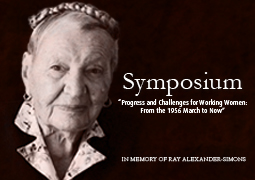
Mrs Ray Alexander-Simons, the late labour unionist and civil rights activist, was today honoured in Parliament for her heroic role in championing the rights of farm workers and women in South Africa.
Her family joined Members of Parliament, academics and civil society organisations in a symposium under the theme: "Progress and challenges for working women: from the 1956 March to now", as part of Parliament's Memory Project aimed at celebrating the lives and contributions of women veterans of the struggle for South Africa's liberation.
Ms Thoko Didiza, House Chairperson: Internal Arrangements in the National Assembly, said the Memory Project is held in "honour of the women of our country who have played a role in different sectors, especially who ensured that we achieved our democracy".
"We also use it to reflect how much have we moved, as Parliament, government and the country, towards achieving the issues that there were concerns about," she said.
The House Chairperson said part of this Memory Project by the Speaker, another struggle veteran, Ms Charlotte Maxeke, was honoured last year and in 2016 we honour Mme Ray Alexander.
"All of us will appreciate that we are going through a difficult time as a country in which we need to ask ourselves what is it that we need to do to ensure that the ideals of those who went before us are not lost, what we need to do in terms of what Mme Alexander stood for," said Ms Didiza.
Mrs Alexander-Simons was described as "a pioneer unionist" and "a practical and very patient mentor" by her friend and fellow trade unionist, Mr Leon Levy, who delivered the keynote address during the symposium.
"If Ray Alexander-Simons landed in Cape Town today, on the 7th of November 2016 and started organising workers five days later, which indeed she did when she landed in Cape Town in 1929, she would find a vastly different scenario," he said.
Mr Levy said the late activist would have her work cut for her, as she would find 3.11 million workers representing 25.3% of the workforce organised in trade unions, a shop steward movement which I believe has 300 000 men and women in almost every industry.
"She will have in her toolbox the most vanguard industrial labour relations, processes and procedures, rights and obligations in the Labour Relations Act,
"She will have legislation on Employment Equity, the Basic Conditions of Employment Act which incidentally updates the one Ray and her fellow unionists fought for in the late 1920s and 30s in the last century," said Mr Levy.
"She would also take a fresh look at the structure and role of the trade unions in South Africa, especially the methods of organisation and the scourge of corruption. And the duplication of trade union organisations competing against each other for members and revenue. For example, there are five unions servicing the transport industry and a large number of unions servicing the security industry - the largest security service in the world, which employs 450 000 people," he said.
Mrs Alexander-Simons's daughter, Ms Tanya Barben, said: "It is appropriate that the function takes place on the 7th of November for it is the date on which teenager Rachel Esther Alexandrowich (Ray Alexander) arrived in Cape Town from Latvia and it is also the anniversary of the October Revolution [which took place in Petrograd, Russia, from the 7th to the 8th of November, 1917]. She was undaunted when facing the bosses, the bargaining councils or the police forces. She sacrificed a lot, including her own family to fight for a democratic South Africa," she said.
By Sakhile Mokoena
7 November 2016
 Arrange a tour