



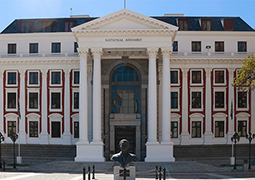
The National Assembly recently held a debate on a Democratic Alliance (DA) proposal to introduce legislative reforms to curb illegal land occupation in South Africa.
During the debate on: “The strain placed on municipal and state resources by illegal occupants of private and state properties, requiring legislative reforms to address various challenges pertaining to illegal land occupation”, DA Member of Parliament Mr Luyolo Mphithi announced that his party has tabled a bill that seeks to criminalise the incitement or organisation of unlawful occupation of land.
“Parliament has the responsibility to answer this crisis and amend the law to ensure that we protect the dignity of South Africans who are still without housing, whilst also protecting property rights as espoused in our Constitution,” he said. The proposed bill will also expand the factors considered by courts when considering applications for eviction, to provide further provisions relating to the availability of alternative housing.
“Unlawful occupation of land must be addressed as a matter of urgency. The current act provides a rigid set of requirements that need to be complied with in order for a person to be lawfully evicted, despite what may be the occupier’s bad faith intentions or true financial circumstances. This has led to lengthy delays of removals, which comes at significant cost to owners and subsequent burden to municipalities,” he suggested.
Mr Mphithi noted that illegal land occupations have the effect of forcing municipalities to provide basic services to occupied parcels of land without having adequately provisioned for the increases in their budgets and alterations in planning frameworks. These expenses, he added, are above those that have already been incurred to safeguard land from unlawful occupation in the first instance.
“Unlawful occupations are now leading to severe dysfunctionalities in urban environments, including the obstruction of sewerage infrastructure, illegal and unsafe connection to the electricity grid, violation of planning legislation and serious health and safety hazards for occupiers and residents alike,” Mr Mphithi said.
He also noted that incidents of illegal land occupations organised by opportunistic criminals and political operators have been recorded, all at the expense of law-abiding citizens.
While acknowledging the challenges posed by illegal land invasions, the African National Congress believes that legislation alone will not solve the problem. Party representative and Chairperson of the Portfolio Committee on Human Settlements, Mr Albert Seabi, said illegal land occupation is not simply an act of defiance against the law but is, in many instances, a manifestation of the enduring legacy of apartheid spatial planning and racially discriminatory land policies.
“People were moved from well-located land and confined to the periphery of cities and economic activity. This created a distorted pattern of land ownership and access, one that persists to date. Legislation alone will not solve the problem. It must be accompanied by accelerated land release, improved urban planning, stronger intergovernmental coordination and increased investment in housing delivery,” said Mr Seabi.
He added that the rapid pace of urbanisation, rising unemployment, poverty and inequality continue to drive demand for land and housing. “This compels many of our people to occupy land out of desperation rather than criminal intent. This reality calls for a compassionate developmental response, not only a punitive one,” he argued.
While the ANC acknowledges the strain illegal occupants of private and state land place on municipal and state resources, Mr Seabi said the matter must not be approached as a matter of legislative reform alone, as doing so would be to ignore the deeper structural realities that continue to shape our society.
“At the same time the rule of law must be upheld, and we strongly condemn the activities of criminal syndicates who exploit the desperation of our people by orchestrating land invasion and illegal land sales,” he said.
The uMkhonto weSizwe Party (MKP) accused the DA of trying to bring back apartheid-style mass eviction laws through this legislative reform proposal. “This is a strategic rewriting of eviction laws. What we see here is a DA-led neoliberal agenda that has found a comfortable home under the administration of Mr Ramaphosa designed to erode the constitutional protection of the poor. Beneath the veneer of administrative efficiency lies a calculated attempt to dismantle the heart of our transformation. We reject this punitive and unconstitutional proposals,” said Mr Thulani Gamede, on behalf of MKP.
He also raised concerns with the proposed fines of up to R5 million for illegal land occupiers and said this was not seeking justice but is rather a back door to mass incarceration.
The fear of bringing back apartheid-style laws was shared by the Economic Freedom Fighters (EFF), who blamed the problem of illegal land invasions on government’s failed land reform programme and the historical dispossessions during colonialism and apartheid era.
“The so-called illegal occupation of land is a direct product of colonial dispossession and apartheid forced removals, and also a direct result of the inability of the post-1994 administration to restore land from settlers back to natives. As long as the state fails to provide land to the people, land occupations are going to intensify,” warned EFF parliamentarian Ms Sharon Letlape.
The Inkatha Freedom Party, through its representative in the National Assembly, Mr Thokozani Langa, supported the need for laws to be strengthened to empower authorities to act decisively at the earliest stages of illegal land occupation.
“The challenge of illegal land occupation cannot be confined to a single department. It is a matter of how the state manages, protects and utilises its land and infrastructure assets. When land is occupied illegally, planned development is delayed, infrastructure pipelines are disrupted and the government is forced into reactive costly interventions,” said Mr Langa.
Sakhile Mokoena
31 March 2026
 Arrange a tour