


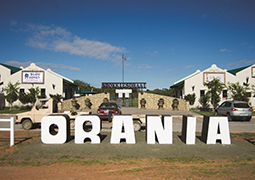
Debating the theme: The threat of enclaves like Orania and Kleinfontein in post-apartheid South Africa to nation-building, nonracialism and social cohesion, Mr Carl Niehaus of the EFF, which raised the motion, declared that the EFF has a burning resolve to speak about the grave and insidious danger race-based enclaves such as Orania and Kleinfontein pose to South Africa’s democracy.
“These are not mere settlements, they are strongholds for racial segregation meticulously designed to fracture our nation,” he said. Their mortal intent is to sabotage non-racialism and to shred the fragile threads of social cohesion and the very soul of our nation-building endeavours, Mr Niehaus said. The EFF calls for such enclaves to be eradicated and the ideologies on which they are based to be eliminated permanently, because “there’s no place for racism in South Africa not now, not ever”, he declared.
Mr David Kgabo (ANC) heartily agreed with Mr Niehaus, as the ANC believes that such settlements represent a direct challenge to the post-1994 democratic transition. “Although they are defended as cultural preservation projects, we should recognise them for what they are: a manifestation of a resistance to our constitution’s commitment to non-racial South Africa. Also, as minority groups that suffer from apartheid hangover,” Mr Kgabo said.
“Their presence represents the persistent right-wing and neo-liberal forces that seek to maintain racist and exclusionary legacies of apartheid,” he concluded.
Mr Nathi Nxumalo (MK Party) suggested, meanwhile, that settlements of this kind are far from innocent cultural symbols. Instead, they fortify white supremacy and racism and we should take steps to confront this festering wound. “In November last year, we invoked rule 130 to challenge the Premier of Gauteng on the legality of these enclaves. We asked hard questions and tabled uncomfortable truths and what we got in response is not even a courtesy of empty platitudes, but silence.”
In his view, this silence is a sign of ANC and DA complicity on the matter. Compounding the problem is that these settlements are nothing less than a “time capsule of Apartheid” as they are “places where no African child may live”. What is more, they were declared unconstitutional by the High Court recently but were never demolished.
Also participating in the debate, Mr Janho Engelbrecht (DA) pointed out that many Afrikaners do not support the ideology adopted by these communities. He also emphasised the DA’s belief in the primacy of the values enshrined in the Constitution, which protect the rights of individuals to freedom of association, cultural expression and self-determination, as long as those rights are exercised within the bounds of the law and the Constitution.
In this regard, we should also recall the constitutional context through which these communities were formed, he said. “They arose out of the perceived fear of marginalisation, of loss of political power during the transition to democracy.”
We are deeply concerned over the persistent expansion of racist enclaves in a democratic South Africa, noted Mr Nhlanhla Hadebe (IFP), for they stand in direct contrast to the values of non-racialism, equality and unity. South Africa’s democratic transition was not about the erasing of cultures and heritage, he said. On the contrary, it affirmed the rights of every community and promoted the practice of their cultures and religions.
Mr Ashley Sauls (PA) declared that enclaves are a threat to nation-building, nonracialism and social cohesion efforts. However, he registered the PA’s concern with the striking similarities between these racist enclaves and the ideology promoted by the EFF. “They both have leaders with racist and separatist ideological views,” he alleged. He went further to underscore his observation. “The EFF ideology is based on an atheist, white-man-thinking Karl Max, who is known to have racist views.”
Continuing with his comparison of the two, he further claimed that Orania and Kleinfontein prefer to sing the Afrikaans part of the national anthem, while the EFF prefers the Sotho and Nguni parts of the national anthem. While these enclaves promote separatist Afrikaner identity, the EFF chants “kill the boer” to promote black separatist identity, Mr Sauls observed. Therefore, South Africans should view both these enclaves and the EFF as threats to nation-building, nonracialism and social cohesion, he reasoned.
The rights to culture, religious practices, self-determination and territorial determination are enshrined in our Constitution, Dr Petrus Mulder (FF+) observed. He also questioned which posed the bigger threat to South African society: the racist communities or political parties that “sow dissent, that intimidate people, that practice division and that long for a revolution” and which “want to cut the throat of whiteness”.
Meanwhile, Ms Lerato Ngobeni (Action SA) suggested that these race-based and racist settlements are proof that Verwoerd is alive and well in post-apartheid South Africa. “Let’s crack the veneer of comfort and the silence of complicity and call this country to consciousness by exposing the threat of these enclaves to the foundation of our democracy.” These are not cultural enclaves, she said, but rather they “promote racial ideological fault lines dressed up as heritage. In essence, they are a betrayal to our democratic promise”.
Abel Mputing
9 May 2025
 Arrange a tour