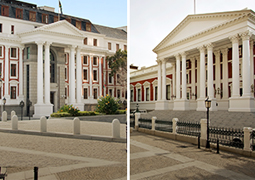
Addressing the official opening of the National House of Traditional and Khoisan Leaders in Parliament today, President Cyril Ramaphosa acknowledged that while unemployment and lack of opportunities are rife across the country, young people in rural and small towns are the most affected by these challenges.
Because of these challenges and poor service delivery, many young people are migrating to urban areas in search of opportunities. “Joblessness, especially among young people, is rife across the country. But its effects are most severe in rural communities. With limited access to opportunities in villages and small towns, many young people migrate to urban centres in search of work, and this affects the local economy and weakens the social fabric. Young people become disconnected from customs and leadership structures,” the President said.
He added that service delivery challenges in local government are felt particularly hard in rural areas. He gave the example of poorly maintained roads, which hamper farmers when they want to transport their goods to market and schoolchildren and the elderly who must travel long distances to get to clinics and schools, costing them money that is already in scarce supply.
The President mentioned the increasing water problems in rural areas, which he said did not only affect households but also small-scale and communal farmers who rely on water to till the land, grow crops and sustain their livestock.
What is more, the President said, “The effects of climate change are worst in rural areas. As we saw with the recent floods in parts of Limpopo, Mpumalanga and KwaZulu-Natal, extreme weather such as floods and droughts affects crop yields and the condition of livestock herds.”
To address the challenges rural communities face, President Ramaphosa noted that the government continues to work with traditional leaders to gain an understanding of the conditions in their communities, of their specific needs and priorities, and to undertake development that is responsive to these realities.
“One area where we are seeing impact is in our efforts to support youth development in rural communities through public employment. The Presidential Employment Stimulus has to date created over 2.5 million work and livelihood opportunities for young people, including in rural areas.”
Meanwhile, “The Social Employment Fund continues to support agricultural interventions for smallholder farmers, including skills development, training in sustainable farming practices and access to markets,” he said.
Another initiative, the National Rural Youth Service Corps, commonly known as NARYSEC, is also having a positive impact on the lives of rural youth. President Ramaphosa reported that last year, many young people in rural areas graduated from this programme, having received training in agriculture, construction, IT, hospitality and other areas.
The President also spoke about the relevance of the institution of traditional leadership in a democratic South Africa and assured his audience that traditional leaders are indispensable partners as the government works to improve the economy and the lives of every South African.
“The institution of traditional leadership forms the sturdy roots that hold the great tree of our nation up. Traditional leadership is the institution that anchors us in history. It nourishes us with identity. It stabilises us when storms rage. In many of the provinces across our country, traditional leaders remain enablers of social cohesion, mediators of conflict, guardians of land and transmitters of culture. Long before the formal architecture of the modern state, there were systems of cogent accountability rooted in consensus and community.
“As the custodians of many of our cultures, customs and shared values that are the source of our nation’s strength, you hold the soil together, anchor the trunk and help us grow taller. Without strong roots, a nation cannot stand,” said President Ramaphosa.
Sakhile Mokoena
26 February 2026
 Arrange a tour