


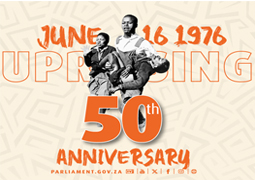
In South Africa, the month of June is Youth Month to commemorate the 16 June youth uprising in 1976. As a result, Parliament hosts one of its youth-related public participation flagship programmes in June every year: The National Youth Parliament. This is a legislative engagement between parliament’s presiding officers, young parliamentarians and youth on the mainstreaming of youth development policies.
Delivering her keynote address at the 2026 Youth Parliament, in Johannesburg City Hall, the Chairperson of the National Council of Provinces, Ms Refilwe Mtshweni-Tsipane, outlined the expected outcomes of this year’s event. “This parliament must interrogate the progress that has been made to reshape and reposition the lives of our youth and children, as set out in our priorities, which underscore a developmental agenda, responsive to the evolving needs of our people.”
This year’s deliberations are predicated on a theme that foregrounds the need for the mainstreaming of youth development policies: Prioritise Youth Development for a Sustainable Future.
This theme is a call for Parliament to devise legislative instruments that are responsive to the plight of the people. “As the youth and professional sector, you are to this end invited to make your individual and collective contributions towards refining our oversight and legislative processes, as a democratic Parliament of the people, by the people and for the people.”
Parliament must ensure that the impact of this year’s deliberations are a means to an end, she urged. “Parliament, as the primary site for oversight will be challenged to translate the outcomes of this dialogue, into measurable outcomes for immediate, medium- and long-term implementation.”
Sketching in broad terms the significance of the day, Ms Mtshweni-Tsipane said the current generation must determine the essence of the 1976 struggle, in order to understand present challenges as part of the long arc of liberation.
“These youth-led struggles of 1976 became the focal point of opposition, when other organisations fighting for liberation were either banned and many leaders in exile, underground or imprisoned.”
This agitation was an affirmation of peoples’ power. “It was characterised as the period of people’s power, where apartheid rule was being displaced in all corners of society, through forms of self-government across our communities.” It was also a psychological warfare that sought to instigate the values of black consciousness. “It was a period for the liberation of consciousness from psychological and political oppression, to rebuild political unity for self-determination.”
The youth protests of 1976 fought against an education system that perpetuated the role of the black population as workers. “In this way, the system sought to ensure the uninterrupted production and reproduction of cheap black labour, for the benefit of white capitalist accumulation, in ways that turned our youth to permanent hewers of wood and drawers of water.”
To ensure the gains achieved since that moment do not become a pyrrhic victory, Ms Mtshweni-Tsipane urged the youth to reclaim education as a site of struggle. They must also exercise their right to vote “o decide the type of country and the world they wish to live in.
She further urged the participants to contribute towards solving the problem of precarious labour in the changing world of work, “to redefine a different development paths and to mobilise a multisectoral compact to accelerate the implementation of youth development policies.”
Pledging Parliament’s commitment to mainstreaming these youth -related development priorities, she noted that Parliament has “committed to become more deliberate and intentional to deepen accountability and strengthen the state capacity to deliver services”.
She urged the participants to remember they are resilient and there’s no amount of humiliation they can’t overcome in life. “This youth parliament is an invitation to you to remember that you are born of a people who turned shame into triumph.”
Abel Mputing
15 June 2026
 Arrange a tour