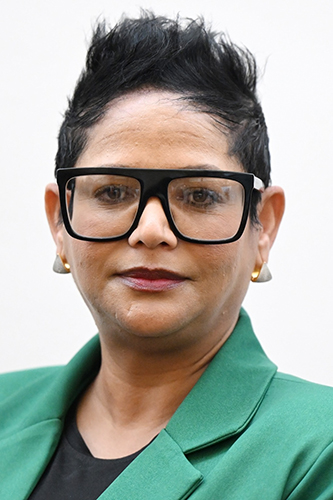



“We need hope in different times and we need to hold the government accountable as young people. The act of savagery, that of the brutal killing of women, has engulfed our nation and we must not be apologetic for being women,” said Ms Dibolelo Mahlasi.
Equally the deaths of George Floyd and Collins Khoza are indicative of the glaring pain black lives face, she pointed out, “we should not condone these acts as the youth, we need to stand up as we did in 1976 and proclaim that black lives matter”.
Turning to the greatest challenge of the current times, she emphasised that for the youth to survive the post-pandemic era, they need a great deal of support, guidance, innovation, and sophisticated competencies to navigate the post-pandemic era.
The National Assembly (NA) hosted a Youth Day debate in a hybrid sitting recently to mark the 44th anniversary of 16 June 1976, a day which is commemorated as Youth Day.
Mr Luvuyo Mphithi said South Africa’s youth are faced with different generational hardships. “Today’s youth are faced not only with unemployment, but with the phenomenon of child-headed households,” he said.
He cited the plight of Themba Mnguni who lost both of his parents as a case in point. “He is a qualified carpenter, but cannot find a job placement as promised at the job summit. While being jobless, he has to look after his siblings. What happened to the promises that were made at the job summit?” he asked.
Mr Mphithi further alleged that the pessimism of the youth is far from over, “for instance, we were mentioned once during the Medium Term Budget Speech,” he said.
“The government could not provide the solutions needed to deal with the growing youth pessimism in this country. As the youth, we know what we need. We need youth hubs that will equip the youth with digital competencies, knowledge about events, and business management, in order to deal with youth pessimism in this country. The government has left the youth with no choice but to demand that we need change and we need it now,” he said.
Ms Naledi Chirwa said the challenges faced by the black youth of 1976 and 2020 are not dissimilar. “They both had/have no access to free education. They both had/have no access to quality healthcare and both were/are landless, and both had/have to endure gender-based violence.
“To alleviate the plight of black youth in this country,” she continued, “we need, among other things, a legislation that will stipulate that 50% of government procurement must be reserved for the youth.”
In addition to that, she said: “The government must support digital entrepreneurs, that is where the interest and future of the youth lies. This will assist in breaking the chain of digital monopoly and youth underdevelopment.”
The 44th anniversary of the 1976 Soweto Uprising is hollow, said Mr Nkululeko Nxumalo. He said: “There is little to celebrate when 8.2 million young people are without jobs. This number has increased since the lockdown. We need to restore a strong sense of active citizenry among the youth and Ubuntu, he demanded, but with the lifting of the ban on the sale of alcohol we have witnessed gender-based violence and the dwindling of Ubuntu and active citizenry.”
There is nothing good to celebrate about this Youth Day, many young people of South Africa have “given up on life”, said Mr Nigel August. He said: “They have turned to drugs and gang violence. There is no day that passes without hearing a story of yet another gang murder, of someone hit by a stray bullet and of someone’s daughter being abused. People are now scared to walk the streets freely because of the youth that are now out of hand.”
Mr Nqabayomzi Nkwankwa said: “As we celebrate this day, we will always be moved by the bravery of the 1976 youth in their fight against racial prejudice, and they will remain a guiding light as we still fight against the same obstacles today.”
He added: “If this debate causes anger, it’s because it is at the centre of our struggle for social cohesion. And if we take stock today of how far we have come, we will realise that we are still the most unequal society in the world.”
Contrary to a popular view, Mr Golden Mahlaule said the crisis of youth unemployment is not a natural disaster. “It’s a legacy of colonialism and apartheid. It did not end in 1994, it has an impact on the current situation.”
The legacy of black underdevelopment “has created a lack of access to education, something that hinders the youth’s access to economic freedom”, he said.
Not only that, he reckoned, “the exploitation of mineral resources during these historical periods mentioned above here have brought about untold structural unemployment and underdevelopment for black people, which led to the intergenerational poverty we experience today”.
It is abhorrent to have political parties today in this Parliament “whose sole existence is to represent white privilege, which defend the legacy of slavery, colonialism and apartheid”, he stated.
Ms Andiswa Masiko said: “In the face of the recent spike on gender-based violence, it is befitting to celebrate the gallant contribution of women such as Antonette Sithole, Sibongile Makhabela, to name but two, in the 1976 uprising, many of whom remain nameless to this day.”
She urged men to stand against gender-based violence, and applauded the state for its strides in instituting gender budgeting in all departments. This will have a positive impact on gender equality.
Mr Mzwanele Nyhontso said: “The weight of history is on our shoulders, today marks our appointment with history. A history which is written in blood. And our appointment with the colonial mentality of police who even kill their own Mr Collins Khoza so senselessly.”
In his view, these acts of violence on the black body, as in 1976, have historical underpinnings that undermine black self-determination, and have their roots in the colonial era.
Mr Buti Manamela, who is the Deputy Minister of Higher Education, Science and Technology, said: “In 1976 we witnessed the transformative power of the youth. We have also witnessed this in the ’80s and in the entrepreneurial spirit of the youth of 2020. It is this spirit that will shape the history and destiny of this country. Of late, we have seen the youth on the front line of the fight against the Covid-19 pandemic.”
To secure the future of the youth, he pointed out, they (the Education Department) are determined to ensure that they save this academic year at all cost. “And we have intensified the funding for youth education. To date, we have invested R8 billion to give access to education to students from disadvantaged backgrounds.”
Politically, he declared that the youth should be mobilised to be at the forefront of change. “We will do what we can for the youth to be the transformative power they have been throughout history,” he said.
By Abel Mputing
18 June 2020
 Arrange a tour