



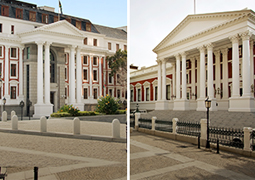
The National Assembly held a 2025 Youth Day debate on the theme: “Skills for a world in the 4th Industrial Revolution – Empowering the youth for transformative economic participation” to commemorate the 1976 youth uprising.
Leading the debate, Mr Noble Tshotetsi (ANC), claimed that education is central in the commemoration of this historic day. “When we reflect on this day, we are reminded of the youth who refused to accept an education system designed to limit their potential.”
To honour their conviction, he said they must ensure that education remains a catalyst for youth empowerment and for their 4th Industrial Revolution readiness to ensure that no youth is left behind in the digital revolution that is shaping our world. Further, he stated, education is not about acquiring knowledge, but also about the transformation of our country’s economic landscape. “We must not accept an economic system that continues to marginalise young people, instead we must forge a path towards their genuine economic freedom.”
He noted that the courageous youth that challenged apartheid regime reminds us that education has always been a weapon for liberation. And their ultimate mission was to attain economic freedom. “We must today acknowledge the need to address structural barriers that continue to hinder the active participation of youth in our economy,” he continued.
Bemoaning the sorry plight of the youth, Mr Mnqobi Msezane, who is also a Member of the NA claimed that he spoke on behalf of the youth who are hopeless, neglected, marginalised and systematically excluded. Youth whose daily reality is shaped by poverty, violence and institutional failure. He said: “To some in this house this debate is a box ticking exercise,” he warned. He further added: “Youth of South Africa, no one is coming to save you. The time has come to confront those who are profiting from our suffering. Let’s unite, mobilise, protest for an end to the modern slavery we are subjected to, he said.
Participating in the debate, Ms Thembisile Khanyile (DA) said what encouraged the youth of 1976 was that what they achieved changed not only their lives, but those of generations that would come after them. She then asked: “Can we stand here today and say the youth of today has the same hope? No, I don’t think so,” she broached.
She explained why.
She said thirty-one years into democracy youth has been locked out of employment opportunities, some are sitting at home with qualifications that are of no use to them because there are no jobs to apply for. At worst, she said, too many youths are leaving school unprepared not only for the job of today, but also of tomorrow. Adding to the already existing crisis of youth unemployment. Behind every youth unemployment statistic is a young woman, a young man denied of livelihood.
Also a Member of the NA, Ms Mbali Dlamini (EFF) said at the heart of 1976 youth uprising was a demand for radical transformation that redefined the balance power and shifted the South African political landscape. She proclaimed that the youth should harness the opportunities presented by the 4th Industrial Revolution through skills development, ownership and clear sense of purpose in this digital age, she opined.
“We can’t,” she disapproved vehemently, “equip the future generation with tools of liberation by relying on outdated Eurocentric and capitalist curriculum designed to uphold the interests of white monopoly capital.” She proffered her solution to that. “We must decolonise our education system from primary school through to university. This should incorporate coding, robotics, data science and renewable energy technologies to ensure that our youth are not left behind, but are equipped in shaping the future,” she stressed.
Mr Sanele Zondo (IFP) said on this day, they are reminded of their duty to create a future in which youth are truly empowered to thrive in a rapidly changing world. While the 4th Industrial Revolution is reshaping every sector of our economy, yet millions of South African youths remain marginalised, underkilled, underemployed and underrepresented in the innovation economy. Also, our youth can’t participate in a digital economy when they are still excluded from connectivity. Because a child without data today, is a worker without an opportunity tomorrow.
“We, therefore, call on the department of education to expand digital literacy by introducing coding academics and innovation hubs at community levels. And industry aligned career mapping initiatives so that our graduates can be employable,” he said.
Let’s strive to create a future where a young person’s worth is not defined by where he/she comes from, but by what he/she can become, said Ms Jasmine Petersen (PA). To recognise that is to recognise the fact that the 4th Industrial Revolution is not a chapter, but a world we now live in. “This is born by the fact that artificial intelligence is now rewriting industries, automation is replacing jobs while data is the new oil and the question is not whether are we ready, but are we bold enough to transform to ensure that youths are not job seekers in this economy, but owners, creators, coders and its leaders.” She said this can be achieved “if there could be a national digital education system that teaches youth in townships and rural areas coding, robotics and entrepreneurship as its core subjects.”
Transformative economic participation of youth in order to be ready for the 4th Industrial Revolution is indeed a very noble prospect, said Ms Heloise Denner (FF Plus). “But for them to benefit from it, they would need technical, soft skills and digital literacy to understand and adapt to new technological tools and software,” she said. This, she said, should be coupled with creativity, emotional intelligence, and entrepreneurial skills to overcome the legislative restraints that keep the youth out of the job market.
Since 1994, we keep hearing the same youth unemployment statistics, the same headlines and the same broken promises, but sadly youth unemployment statistic is not just a number, it affects you and me, said Ms Malebo Kobe (Action SA). “For most of my 20s, I lived a brutal reality of unemployment and when I got learnership I got a relief, but when it ended, we were told to go. Not because we were not good, not because there were no jobs, but because those jobs were reserved for the select few who were connected,” she claimed.
We are keenly aware of the changing job market to artificial intelligence, robotics and automation and as this change accelerates it will further displace young workers who don’t have these skills and who are already affected by the spiking rate of unemployment, said Mr Wayne Thring (ACDP). Unless there’s reskilling and absorption of youth into labour intensive industries such as mines and agriculture. To that effect, he said, “we urge our government to expedite beneficiation from our raw materials, manufacturing and agro-processing industries to absorb the unemployed youth,” he said.
Every single year we stand on this podium to talk about youth unemployment, and I have been a member of Parliament for more than 10 years and we have been having this debate and nothing concrete has been done to address youth unemployment, said Mr Nqabayomzi Nkwankwa (UDM). Ironically, we are rich in minerals, but there hasn’t been an investment in beneficiation to process minerals into high value products for local and overseas markets. This would, in turn, create industries that would employ many unemployed young people of this country, he said.
Our youths are not our future, they are our present and are filled with energy and dreams, but yet economically they are left behind. As a result, “their hope is delayed, and dreams are dimmed and futures kept on hold. Most of whom even struggle to finish school or go to university, claimed Mr Makashule Gana (Rise Mzansi). This, he said, has not only rendered them unable to find jobs, but also unable to create them, he said.
Sadly, many here speak as if they are mere spectators that do not have the executive powers to act and do something about youth unemployment, said Ms Nobuntu Hlazo-Webster (Bosa). “Stop gaslighting young people, stop outsourcing your duty. The people who can change the lives of young people in South Africa are in this house. We need job focused leadership and that will wage war on red tape and champion township entrepreneurs and unlock SMMEs to absorb millions of unemployed youths in this country,” she urged.
Abel Mputing
11 June 2025
 Arrange a tour