



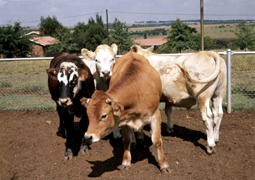
The Select Committee on Agriculture, Land Reform and Mineral Resources attended a workshop with all nine provincial legislatures over the weekend on foot-and-mouth disease (FMD).
In his opening remarks, the Chairperson of the Select Committee on Agriculture, Land Reform and Mineral Resources, Mr Mpho Modise, expressed his reservations about the vaccines reported to be distributed to dairy farmers. “I am told they are launching a vaccination drive. The national department has indicated that they are expecting about one million vaccines. Will it be sufficient to give one million vaccines to farmers in milk production when we have farmers in beef production as well? What about them? Can we then lobby the department to say, ‘Inasmuch as we give a million to the dairy farmers, we must also consider the beef farmers?’” said Mr Modise.
The Department of Agriculture recently briefed Parliament on the vaccination of cattle against FMD; the vaccinations are in response to outbreaks across the country. KwaZulu-Natal is the leading province in FMD cases, with the department reporting outbreaks in all provinces. The Free State is recording increases, making it the second-leading province after KZN.
One million vaccine doses will be distributed across the nine provinces in outbreak areas, while plans are under way to vaccinate the country’s entire herd of over 14 million cattle.
KwaZulu-Natal and the Free State have been allocated 200,000 doses each, while North West, Mpumalanga and Limpopo will receive 100,000 doses. The Eastern Cape has received 150,000 doses.
Mr Jaco Mulder, the Chairperson of the Portfolio Committee on Environment, Agriculture and Rural Development in Gauteng, said, “We gather here not merely to attend a workshop. We gather here in response to a national threat. We gather here because behind every livestock truck halted, every auction postponed and every farm placed under quarantine, there is a family whose livelihood hangs in the balance.
“Foot-and-mouth disease is not just an animal health issue; it is an economic threat. It is a food security threat. It is a threat to livelihoods. It threatens farmers, farm workers, rural communities, municipalities and the entire agriculture and red meat value chain that sustains our nation.
“For perhaps the first time, oversight leadership from all the provincial legislatures, together with the national Parliament, the executive, national, provincial and local government, and key stakeholders from the farming, cattle and red meat industries, have come together in one forum, united by one purpose: to confront this crisis with urgency, unity and accountability,” said Mr Mulder.
Mr Modise stated that the financial losses resulting from international export bans, as well as livestock losses, have been significant. “While we welcome the roll-out of the vaccines, it must be noted that many stakeholders in the industry are frustrated by the slow pace of the government’s response to the FMD crisis. This revolves around chronic vaccine shortages, a slow government response to FMD outbreaks, and the [national] department’s insistence on remaining the sole regulator and supplier of the FMD vaccine while struggling to show any ability to contain outbreaks of the disease,” said Mr Modise.
Gauteng Agriculture MEC Ms Vuyiswa Ramakgopa said, “Gauteng, of course, being a logistics hub and a commercial centre for agriculture and many other sectors, has certainly been affected. Since the beginning of this outbreak, we have recorded 297,413 cases to be exact. She added that over this period, the provincial government has administered 288,315 vaccine doses. “This is a moving target and, now that we are under way with our most recent vaccination roll-out, that number will of course change daily. We have also had incidents where 128,925 animals have undergone controlled slaughter.”
The Gauteng Department of Agriculture said the problem in the province is predominantly in the southern part of Gauteng. Dr Wynton Rabolao said, “The question always arises as to why we have quite a number of outbreaks in those particular areas. The answer is that question is that when you look at those geographical areas, we have a lot of informal settlements, number one, and secondly, quite a number of livestock keepers.
“We do not necessarily refer to them as farmers, but people who keep livestock on the outskirts of townships. It is a communal set-up. Hence, we have a high incidence death rate in those particular areas, because it is often very difficult to put a communal herd under quarantine. If it is a farm with fences and gates that can be locked, it is quite easy. Once we have set quarantine, we know that those animals will be restricted to that particular farm.”
In a communal set-up, the animals are corralled at night and released in the morning. Depending on where the herdsman seeks grazing, they may be taken north, south or west. When the outbreak started, the Gauteng government explored the idea of keeping these animals in the corrals and feeding them there, Dr Rabolao explained. However, there was a challenge because there is no water in those corrals. Inevitably, the animals have to be released in the morning in search of water. This situation is not unique to Gauteng, but is common to provinces with communal herds, because the animals belong to more than one owner. In most instances, one does not even deal directly with the owner, but with the herdsman.”
The KwaZulu-Natal Chairperson of the Portfolio Committee on Agriculture and Rural Development, Mr Super Zuma, said, “We mustn’t treat this as a challenge for a particular province. It is a challenge for the entire country. It has impacted food security and economic growth in the provinces, as well as the country.”
Members of the provincial legislatures expressed their appreciation for the opportunity to participate in the discussion and address the challenges. They emphasised that strengthening communication campaigns and educating the public about the disease are of paramount importance.
Yoliswa Landu
2 March 2026
 Arrange a tour