


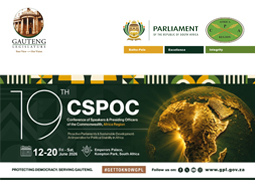
The issue of migration featured prominently during the opening of the 19th Conference of Speakers and Presiding Officers of the Commonwealth Africa Region (CSPOC Africa), currently underway at Emperors Palace in Ekurhuleni.
The conference has brought together representatives from more than 50 African countries, including Speakers, Presiding Officers and heads of provincial legislatures, to deliberate on parliamentary democracy, governance, accountability and sustainable development.
Delivering remarks on behalf of President Cyril Ramaphosa, the Minister of International Relations and Cooperation, Mr Ronald Lamola, called on legislatures across the continent to hold their respective executive branches accountable for progress in addressing the root causes of migration.
“I also implore you, Members of Parliament, in your parliaments, to measure your own executives on how far we are going with regional integration, the Africa Free Trade Area and cross-border economic zones, because these initiatives will provide significant opportunities to grow the African economy and create jobs across the continent, enabling all of us to make a meaningful contribution to the future of our children,” Minister Lamola said.
The Minister highlighted several factors contributing to increased irregular migration, including economic hardship, unemployment, growing hostility towards migrants and refugees, divisive politics, escalating conflicts, deindustrialisation, weakening labour protections and stagnant economic growth.
“And while migrants did not create these problems, they have increasingly become convenient targets for frustrations rooted in much deeper economic and social challenges, including competition for limited economic opportunities, jobs and access to services such as healthcare and education,” he said.
Minister Lamola strongly condemned violence directed at migrants and refugees, describing it as inconsistent with South Africa’s constitutional values. “Violence directed at migrants and refugees is a blight on our democracy and a betrayal of our Constitution’s promise of dignity, equality and fundamental human rights for all,” he emphasised.
Reiterating President Ramaphosa’s position on immigration enforcement, Minister Lamola stressed that responsibility for enforcing immigration laws rests solely with the state. “No grievance, however legitimate, gives any individual or organisation the authority to demand identity documents, remove people from public facilities, or drive them from their homes and businesses,” he said.
Reflecting on South Africa’s historical experience with migration, Minister Lamola noted that migration has long been part of the country’s social and political fabric. He outlined measures adopted by the democratic government to protect the rights of migrants and refugees.
“This is the reason our young democracy approached migration with an unwavering humanitarian and Pan-African commitment. We enshrined the rights of migrants in our Constitution, acceded to international conventions protecting migrants and refugees, restored citizenship to people from whom it had been arbitrarily denied, and dismantled racist policies that favoured white migrants from neighbouring countries and beyond,” he said.
The Minister also encouraged delegates to engage with migrant communities from their respective countries during their stay in South Africa and to encourage adherence to local laws. “You will be here for the next three days. I invite you to take the excursion opportunities to visit some of our townships and communities and engage with members of the African diaspora in South Africa from your countries. Encourage them to be law-abiding residents,” Minister Lamola concluded.
The conference continues over the next three days, with delegates expected to discuss a range of issues related to strengthening parliamentary institutions, promoting political stability and advancing sustainable development across Africa.
Malatswa Molepo
17 June 2026
 Arrange a tour