


The Parliamentary Budget Office (PBO) has called for stronger developmental spending on social and economic infrastructure, public services, and industrial, township and rural economies.
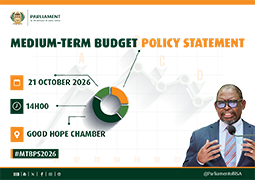
The call was made during a joint meeting of the Standing Committees on Finance and on Appropriations, the Select Committees on Finance and on Appropriations where the committees were briefed by the Parliamentary Budget Office and the Financial and Fiscal Commission (FFC) on the Medium-Term Budget Policy Statement (MTBPS).
The joint meeting was an opportunity for members of the National Assembly and the National Council of Provinces to examine the implementation and service-delivery implications of the Minister’s policy proposals, as set out in the MTBPS.
The 2026 MTBPS proposes a fiscal path aimed at stabilising public debt, accelerating infrastructure investment and improving basic services amid subdued economic growth and persistent expenditure pressures.
Meeting Co-Chairperson Dr Mmusi Maimane emphasised the importance of processing the MTBPS and the accompanying bills before the committees as part of their oversight mandate. He emphasised that the equitable division of nationally raised revenue requires transparent, accountable and effective financial management across the three spheres of government, local, provincial and national.
The MTBPS process is further regulated by the Money Bills Amendment Procedure and Related Matters Act of 2009, which requires Parliament to consider, among other matters, the government’s medium-term spending priorities, the proposed division of revenue and substantial adjustments to conditional grants.
PBO policy analyst Dr Mmapula Sekatane said the MTBPS priorities were in line with the 2026 budget and priorities identified during the State of the Nation Address. Dr Sekatane said the government will strengthen high-impact primary healthcare interventions to improve maternal nutrition, support healthy pregnancies and promote optimal child development during the first 1 000 days of life.
The PBO warned that South Africa’s economic growth is expected to remain below the government’s Medium-Term Development Plan (MTDP) target of more than 3% by 2029. According to the PBO, even National Treasury’s more positive economic outlook, which assumes that government reforms will succeed, is unlikely to achieve this target.
The PBO also said it expects unemployment to remain above 30%, with little improvement in poverty and inequality over the Medium-Term Expenditure Framework (MTEF) period.
The PBO also raised concerns that the MTBPS continues to focus mainly on managing government finances, reducing debt and meeting budget targets, while giving insufficient attention to South Africa’s pressing challenges of unemployment, poverty and inequality. The PBO suggested that budget decisions should be assessed against implementation quality and measurable citizen outcomes, not fiscal targets alone.
Mr Paul Swart, a member of the Select Committees on Appropriations and Finance in the National Council of Provinces said the government should recognise that municipalities are no longer financially viable. Mr Swart warned that municipalities should not receive bailouts without measurable targets.
Meeting Co-Chairperson Dr Joe Maswanganyi said municipal spending should be measured by improvements in services and impact on communities. “Oversight of water infrastructure should assess whether completed projects benefit communities, rather than focusing solely on the amount spent,” he said.
The FFC said it has identified persistent weaknesses in productivity, capital formation and employment as key constraints on South Africa’s growth performance.
28 October 2026
Jabulani Majozi
 Arrange a tour