



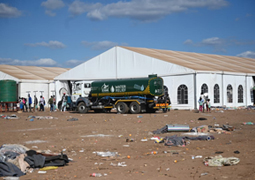
The Portfolio Committee on Home Affairs has concluded that sustained investment in border security is essential if South Africa is to break what it described as the “deportation and repatriation revolving door”, where thousands of undocumented foreign nationals are repeatedly processed for deportation while weaknesses at South Africa’s borders continue to undermine immigration enforcement.
The conclusion follows the committee’s urgent two-day oversight visit to Musina, Limpopo, where members inspected the temporary repatriation processing centre (TRPC) and the Beit Bridge Port of Entry to assess the implementation of immigration legislation, South Africa’s repatriation programme and the Border Management Authority’s (BMA) operational readiness.
Committee Chairperson Mr Mosa Chabane said the oversight visit had reinforced the need for South Africa to strengthen its border management capability if it is to achieve lasting success in managing migration.
“While the country has demonstrated its ability to process and repatriate large numbers of undocumented foreign nationals in a lawful and humane manner, this effort will have limited long-term impact if we do not invest adequately in securing our borders,” Mr Chabane said. “South Africa cannot afford a cycle in which people are repeatedly deported only to find their way back through vulnerable sections of our borders.”
During the first leg of the oversight visit, the committee inspected operations at the repatriation centre, where it received a comprehensive briefing on the processing, verification and repatriation of undocumented foreign nationals.
Committee members were informed that more than 38 000 undocumented foreign nationals had been processed in less than a week by 4 July 2026, with the cumulative number subsequently exceeding 45 000. The committee also observed the registration and processing systems and noted the coordinated efforts of the Department of Home Affairs, municipalities, law enforcement agencies, diplomatic missions and humanitarian organisations in ensuring that immigration laws are implemented while safeguarding the dignity and fundamental rights of those undergoing the repatriation process.
“The committee was encouraged by the level of coordination demonstrated by all stakeholders involved. Processing thousands of people within a short period while maintaining humanitarian standards illustrates what can be achieved through effective collaboration across government and its partners,” said Mr Chabane.
The committee also acknowledged the support provided by the Limpopo and KwaZulu-Natal provincial governments and their municipalities in supplementing national government resources during the operation.
The second day of the oversight visit shifted the committee’s attention from repatriation to border prevention, with members inspecting operations at the Beit Bridge Port of Entry. There, the committee identified significant infrastructure, technological and human resource constraints that continue to limit the BMA’s effectiveness.
Among the challenges highlighted was the shortage of body-worn cameras, with only 40 cameras currently available for approximately 600 border guards deployed across South Africa's ports of entry and border law enforcement operations. Committee members also noted that luggage transported on passenger buses is still searched manually because of inadequate scanning technology, creating operational vulnerabilities and limiting officials’ ability to inspect all baggage efficiently.
The committee further found that staffing shortages require border guards to perform immigration administrative functions, reducing the number of officials available for frontline border protection. Officials also reported outdated software systems, insufficient operational equipment and reliance on a single battery-powered mobile scanner whose use is interrupted whenever it requires recharging.
Committee members were also briefed on the deployment of drone technology for border surveillance. The BMA currently operates only four drones nationally, supported by eight qualified drone pilots, a capacity the committee believes is inadequate for monitoring South Africa's extensive borderline. Mr Chabane said these constraints demonstrated why investment in the BMA should be viewed as a national priority.
“Our oversight has shown that the BMA is making meaningful progress despite operating under extremely difficult circumstances. However, inadequate funding, limited personnel and outdated technology continue to constrain its ability to fulfil its constitutional mandate. Investing in modern technology, skilled personnel and operational resources is not simply about strengthening one institution; it is about protecting the country’s sovereignty, facilitating legitimate trade and travel, combating transnational crime and ensuring that immigration laws can be enforced effectively,” he said.
He added that strengthening border security would complement the significant work already being done at repatriation facilities. “Effective border management begins long before an individual reaches a repatriation centre. If we strengthen prevention at our ports of entry and along vulnerable sections of the borderline, we reduce pressure on detention and repatriation facilities while creating a more efficient, secure and sustainable immigration system.”
The committee will now compile a comprehensive oversight report containing its observations, findings and recommendations for Parliament’s consideration. The report is expected to inform future engagements aimed at strengthening border governance and ensuring that BMA is adequately resourced to discharge its responsibilities effectively.
The committee believes that the lessons from Musina demonstrate that while coordinated repatriation efforts remain important, sustainable immigration management ultimately depends on a modern, well-resourced and technologically enabled border security system capable of preventing irregular migration before it occurs.
Justice Molafo
10 July 2026
 Arrange a tour