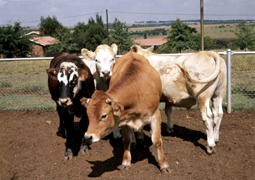
The Portfolio Committee on Agriculture today received an update from the Department of Agriculture on the vaccination of cattle against foot and mouth disease (FMD), following an outbreak across the country.
While KwaZulu-Natal is the leading province in FMD cases, the department reported outbreaks in all provinces, with Free State recording increases making them the second leading province after KZN.
The committee heard that one million vaccine doses will be distributed across the nine provinces in outbreak areas, while plans are underway to vaccinate the country’s entire herd of over 14 million cattle.
KwaZulu-Natal and Free State have been allocated 200 000 doses each, North West, Mpumalanga and Limpopo 100 000, while the Eastern Cape received 150 000.
The department reported that the distribution of the vaccine is done according to risk. As a result, Gauteng received 70 000, while Northern Cape and Western Cape got 50 000 and 30 000 doses respectively.
“The reason for Western Cape and Northern Cape to get so little is that at the time of distribution they had very few outbreaks. We are just going to manage the situation,” said Dr Botlhle Modisane, the department’s Chief Director for Animal Health and.
In addition to the vaccination rollout, the department is also implementing movement restrictions for animals and animal products from quarantined farms, along with the disposal of high-risk parts of the carcass after slaughter.
Dr Modisane said the department is also implementing measures for the identification and traceability of infected and vaccinated cattle, surveillance in affected areas to detect early infection, and enforcing the requirement for the owner to obtain a health declaration for livestock prior to movement and 28 days isolation after.
The department reported various challenges, including illegal movements of animals from affected areas, false health declarations by owners, sending animals with clinical signs to auctions and abattoirs, insufficient state veterinary personnel on ground level, and interrupted vaccine availability.
Committee members raised concerns about the inadequate implementation of control measures to prevent the movement of livestock from affected areas, stray animals that cross boundaries without any monitoring and, in some provinces, livestock that graze along the fences of reserves where there are buffaloes.
The Minister of Agriculture, Mr John Steenhuisen, strongly disagreed that the government’s response was reactive with no plans for future outbreaks. “It is reactive in terms of the current outbreak, but the broader plan is to vaccinate the entire herd. The strategy is to ensure that we are ahead instead of chasing outbreaks; this could be the last major outbreak,” he said.
Mr Steenhuisen added that while movement control is an important measure, it would be foolhardy for the department to rely on it when it is not being adhered to. He also explained the role of the Ministerial Task Team, which he said was to provide technical and scientific advice for the department and minister.
Committee Chairperson Ms Dina Pule thanked the Minister and his team for the update on the department’s response to the FMD outbreaks. “This is one of the priorities for the committee and we hope next week you will be able to update us how far are you with the vaccination in the provinces, including the engagement with National Treasuring on funding of the vaccination campaign,” she said.
The committee is also considering conducting oversight visits to the Free State following reports that cases are on the rise in that province.
Sakhile Mokoena
23 February 2026
 Arrange a tour