



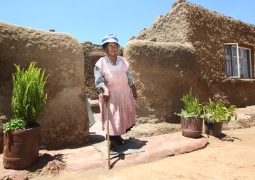
Tabling the Department of Human Settlements’ plans and budget vote for the 2024/25 financial year in the National Assembly this week, Minister Mmamoloko Kubayi announced that upgrading informal settlements and eradicating mud houses in rural areas will be among the department’s top priorities for this year.
“We have allocated R4,5 billion towards the Informal Settlement Upgrading Partnership Grant and R8.7 billion Urban Settlements Development Grant for the Metros, and for the provinces on the Human Settlements Development Grant, R13,7 billion has been allocated and on Informal Settlements Upgrading Partnership Grant, the total amount is R3.3 billion to ensure the fast-tracking of the delivery of sustainable human settlements,” said the Minister.
She explained that the informal settlements upgrading programme was introduced to improve the living conditions of citizens who live in unsafe and uninhabitable environments. “Where suitable, the programme prioritises the incremental upgrading of these settlements, failing which, we permanently relocate all the settlements that are in disaster prone areas,” she said.
Minister Kubayi also reported that the number of informal settlements that have been formalised and completely provided with permanent infrastructure remains low and this prompted the department to review the monitoring and intervention approach for the 2024/25 financial year by introducing several workstreams that will enhance technical implementation support.
The department will work closely with non-governmental organisations to re-block informal settlements households to mitigate against disasters and use spatial location technologies to geo-map all informal settlements to fast-track the physical upgrading of each of the informal settlement.
“Due to huge labour redundancy in the rural areas, multitudes will continue to flock into cities seeking economic opportunities and a better life. Because of their effect on housing demand and supply patterns, all these changes have an impact on how we conceptualise, plan and develop human settlements.
“This means that we must reconfigure and recalibrate the human settlements delivery system that is capable, adaptive and innovative. In this regard, we have made an urgent priority to resolve the bottlenecks that have hindered our commitment of digitising the beneficiary list system because it will radically improve our operations as a department,” the Minister said.
She tabled a total allocation of R33.1 billion, of which 96% or R31.6 billion is allocated towards transfer payments. Transfer payments consist of conditional grant allocations (R30.1 billion), transfers to entities amounting to R1.5 billion and other transfers that make up about R10 million. The Emergency Housing Fund budget of R496.7 million constitutes 1% of the total budget.
Participating in the budget vote debate on behalf of the African National Congress, the Chairperson of the Portfolio Committee on Human Settlements, Mr Albert Seabi, said they supported the department’s budget and hoped it will be spent effectively to eradicate homelessness and better the lives of the people.
He also commended the department for progressive legislation and policies as well as massive housing programmes that have addressed homelessness and prioritised vulnerable groups in society in the last three decades.
“Today millions of people have a place to call home. Government has empowered people with property that they can pass on to future generations,” said Mr Seabi.
Mr Luyolo Mphithi of the Democratic Alliance called on the Minister to ensure that provinces and municipalities spend their allocations to address the housing backlog. “It is simply unfair and unjust that funds are not spent and are being returned to National Treasury year on year when people are waiting for promised houses.
“The Department of Human Settlements is the main vehicle for the delivery of integrated sustainable human settlements. It must prioritise the dignity of South Africans who continue to suffer the indignity and brutality of lack of shelter,” Mr Mphithi said.
Mkhonto Wesizwe Party was represented by Mr Sydwell Masilela in the debate and he also emphasised the need to speed up the process of building houses for the poor to address the existing backlog. “The miserable living conditions of black people in informal settlements attest loudly to the legacy of apartheid and we don’t believe the Government of National Unity will be able to eradicate these,” said Mr Masilela.
Commenting on the matter of land unavailability for housing development because it is either under private hands or owned by corporates, Mr Masilela advised that government land must be released for housing development.
The Economic Freedom Fighters’ Ms Mbali Dlamini said: “Our people are still living in apartheid planning, using bucket toilets in the 37 municipalities that have failed to eradicate the bucket toilets. According to Statistics South Africa the number of people using bucket toilets in these apartheid townships is on the rise.”
She proposed the establishment of social housing companies in all the provinces and digitise the housing beneficiary waiting list.
Sakhile Mokoena
18 July 2024
 Arrange a tour