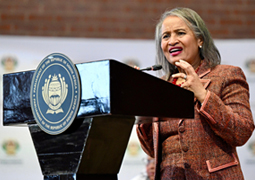
Three decades after the Beijing Declaration, women’s rights advocate Ms Geraldine Fraser-Moleketi has warned that the time for commemorative statements is over. She called instead for governments and institutions to be held accountable through enforceable mechanisms that deliver real economic and social change for women.
Delivering a commemorative message as Chairperson of the Beijing +30 African Women’s Movement, Ms Fraser-Moleketi reflected on the significance of the 2026 Women’s Parliament being hosted in Kimberley in the Northern Cape, a province she described as personally meaningful because it was her first constituency province as a Member of Parliament. She recalled entering Parliament at the age of 34 and used this reflection to underline the importance of intergenerational leadership and the continuous sharing of knowledge between women of different ages and experiences.
She noted that South Africa’s contribution to the Beijing Declaration and Platform for Action was grounded in work already done locally to deepen the country’s position and strengthen the global framework. However, she stressed that international and regional frameworks must not remain aspirational. Instead, she said, they should be used by the women’s movement as tools to hold governments accountable for translating commitments into measurable impact.
Ms Fraser-Moleketi also acknowledged the democratic gains made through the labour of women from all walks of life, including the representation of young women in key public portfolios such as Electricity and Energy. She praised the Women’s Parliament as a bold initiative that brought together women from legislatures, the judiciary, all spheres of government and communities more broadly.
At the same time, she cautioned that hard-earned rights are under growing pressure from anti-rights movements, particularly in the area of sexual and reproductive health and rights. Ms Fraser-Moleketi emphasised that there can be no economic emancipation without bodily autonomy, pointing to the need for progressive laws to be matched by accessible healthcare services, reduced stigma and reliable supplies.
Her message placed strong emphasis on gender-responsive budgeting and enforceable legislation, arguing that policy must be designed and implemented in ways that materially improve women’s lives. She called on every sector – government, civil society, politicians, interfaith spaces and the private sector – to play its part in advancing women’s rights and economic justice.
Quoting the shift from Beijing+30 to Agenda 2063, Ms Fraser-Moleketi said the central question is no longer simply whether women work, but whether women own. She argued that an era in which women are confined to survivalist, informal and unpaid care work must come to an end. They must, she proposed, own their destiny through business ownership and political leadership
She concluded with a clear call for the resolutions and commitments of Parliament to be tracked and implemented rather than archived, saying the next phase of the women’s movement must be defined by accountability, ownership and delivery.
 Arrange a tour