


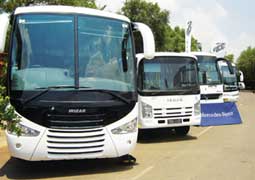
The Select Committee on Education, Sciences and the Creative Industries heard on Tuesday that a draft policy is on the way to bring about synergy in the implementation of the scholar transport programme.
The Minister of Basic Education, Ms Siviwe Gwarube, told the committee that there are inconsistencies in the programme’s implementation across the country. This is a challenge at a time when fiscal constraints are affecting all government departments. “The situation will impact provinces more and they will struggle to do more on what they have. Some scholars deserve to be on the scholar transport programme but are unable to access it,” Minister Gwarube said.
The committee heard that 667 000 students made use of the programme and 2.8 million were using private scholar transport (arranged by parents). “We want to get all these learners to government’s subsidised scholar transport,” said a DBE representative.
DBE was also accompanied by a delegation from the Department of Transport, which has this responsibility in the Eastern Cape, Mpumalanga, KwaZulu-Natal and Limpopo.
Members of the committee had questions on a range of issues including the training and vetting of drivers; the impact the early childhood development function has on scholar transport since it has moved from social development; and the impact of taxi violence in areas where the function is performed by taxi operators. Committee members also wanted more information about the groups of learners who stopped attending school in the North West due to the lack of scholar transport and different modes of funding, considering budget constraints.
Committee member Nkosi Mwelo Nonkonyana said he would appreciate data around instances where the programme was affected by taxi violence, especially in the Eastern Cape, where some schools are serviced by taxi operators. “This was a hot issue, the Premier set up a commission to look into that,” he noted.
Minister Gwarube said the programme is funded via the equitable share and that the department has considered increasing the programme’s reach. The department has also met with National Treasury to discuss funding shortages.
The department’s Director-General, Mr Mweli Matanzima, promised to provide written responses to the committee’s questions but said the department is in favor of introducing a conditional grant model for scholar transport. However, the provinces are not in favour of this idea because it takes away provincial governments’ freedom to make spending decisions and programme allocations. Conditional grants are more stringent in that funds are only used for the purpose for which they were allocated and unused funds are returned to Treasury. Thus, scholar transport will be better secured if it is funded through conditional grants.
Mr Matanzima committed to follow up on the status of the North West learners and noted that as the early childhood development function is newly transferred to the Basic Education department, its impact on the department’s finances and operations is not yet clear.
The Chairperson, Mr Makhi Feni, welcomed the briefing, saying it is important for the transformation agenda.
He had earlier welcomed the report findings from the Gauteng Department of Education on claims of racism at Pretoria High School for Girls, saying that the committee supports its findings.
In addition, he said: “We support wholly the implementation of the Basic Education Laws Amendment (BELA) Bill and would like to encourage those who are unhappy to make submission on the clauses that are subject of discussion. The signing of the BELA Bill is not by any chance a mistake. That is a progressive piece of legislation that works to advance the transformative agenda. Everyone will be accommodated; hence some clauses remain open for submissions from the public,” he said.
Sibongile Maputi
6 November 2024
 Arrange a tour