


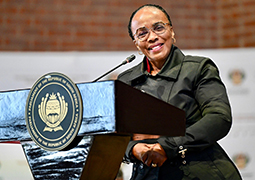
Speaking during Women’s Parliament yesterday at Sol Plaatjie University in the Northern Cape, the Minister in the Presidency for Women, Youth and Persons with Disabilities, Ms Sindisiwe Chikunga, boldly stated that we have every reason to celebrate.
To support her claim, she explained that 70 years ago, when the women who came before us marched to the Union Buildings, women’s lived realities were a far cry from where we are today. She continued with her comparative analysis. “The women had no vote. They had no standing in law. Many of them could not open a bank account without a man’s signature. Yet, despite this level of dehumanisation, they had a vision which is now 72 years old.”
Two years before that march, in 1954, the women of this country adopted the historic Women’s Charter. That is where the 72 years of vision in our theme begins. So visionary and progressive were women that their demand for equal rights without regard to one’s race or gender was raised way before these principles became the cornerstones of our democratic constitution in 1996, Ms Chikunga claimed. And they envisioned what a new South Africa should look like.
They also went on to define the form and nature of such a country. As a country that guarantee “equality before the law, equal pay, the right to own property, paid maternity leave, childcare, and an end to the laws that made a woman a permanent minor.”
As a result, Ms Chikunga added: “Today, a woman is no longer a minor in law. A woman may own land in her own name, inherit from her father, and remain in her home after her husband dies.”
Beyond that, women have, due to exist gender equity instruments, enjoyed a fair share of representation compared to the past. She gave statistics to foreground her observation. “Women make up 43,5% of our National Assembly, up from 28% in 1994. Forty-five percent of our judges are women, up from two women in 1994, and a South African woman has served as Chief Justice of this Republic. More than sixty percent of our university graduates are women. Since 1994, nearly 3,4 million housing subsidies have been approved, and fifty-eight percent of them went to women.”
Given the above, she maintained, “we have every reason to celebrate. Let us celebrate the domestic worker who is now protected by law. The farm worker who now has a minimum wage. The girl in Galeshewe who will finish matric this year, in a country where in 1996 fewer than sixteen percent of women had done so.”
The Barriers That Remain
In spite of these advances, she conceded, we remain far from where we wish to be. She reasoned: “Seventy years later, women continue to navigate a complex landscape of intersecting oppressions rooted in colonial legacies, neo-colonial extraction, patriarchal structures, and global economic injustice.”
Economically speaking, Ms Chikunga claimed that the government’s approach to building resilient economies cannot ignore the disproportionate burden women continue to carry on behalf of everyone. “When a clinic closes, a woman nurses the sick at home. When a creche closes, a woman stays home. The legacy of those decisions is still carried on the backs of African women, and reversing it will take deliberate law , deliberate policy and most of all, deliberate action.”
That is why our department is developing a care economy strategy for South Africa – so that the work which holds this country together is counted, supported and paid.
Advancing Gender Justice, Equality and Resilient Economies
First: land, property and productive assets
The laws to achieve the above are in place. What we must now accelerate is funded reform programmes because for African women, land is not merely property. It is identity, heritage, spirituality, livelihood, and wealth passed between generations, Ms Chikunga said.
Yet systematic dispossession continues. “Women make up the majority of Africa’s agricultural workforce but own only a small fraction of its agricultural land. Customary tenure systems recognise a woman’s right to use land while systematically excluding her from owning it, controlling it, or passing it on to her children.”
Securing women’s rights to productive assets is thus no longer an option. It is the precondition for everything else we say we want, Ms Chikunga emphasised.
To advance the economic empowerment of women, the Minister recommended structured and sustained mentorship programme to introduce young women to the value-chain of critical economic sectors such the mining industry, agricultural sector, maritime industry. Young women also need to be introduced to science, technology and maths-related careers so that they gain the economic leverage they need to be financially independent beings empowered to determine their own future.
 Arrange a tour