


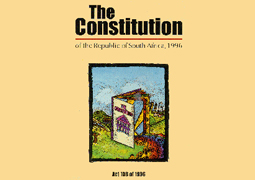
The Minister of Justice and Constitutional Development, Ms Mmamoloko Kubayi, recently delivered a statement in the National Assembly to mark the 30-year anniversary celebration of Sout Africa’s Constitution.
She noted that the adoption of the Constitution, on 8 May 1996, marked a significant and irreversible moment in the people’s march towards a united, non-racial and non-sexist democratic South Africa. “Our constitution did not only qualify the norms and procedures our democracy, but it also gave an expression to the aspirations of the majority of South Africans, thus becoming an also integral part of who we are as South Africans.
“The diversity of the parties that are represented here today is a testament to the enduring legacy of what the constitution has made possible in the ever-evolving political landscape of our country,” she said.
The Minister paid homage to the drafters of the Constitution for producing the supreme law of the land that equally binds the legislature, executive and the judiciary, and for setting a framework to achieve peace, unity and stability after many years of painful and violent struggle.
“Our Constitution was also drafted to lay a foundation of a South African society so as to heal the divisions of the past and establish a society based on democratic values, social values and fundamental human rights.”
Minister Kubayi also outlined a year-round programme of celebrations of thirty years of the Constitution, which will include public dialogues, civic education, cultural events, youth engagements, symbolic events at historical sites and other community-driven initiatives to deepen constitutional awareness and social cohesion.
“We celebrate thirty years of our constitution, not that it is perfect, but it is vital framework for the sustenance of our democracy, progressive realisation of human rights and accountability. Not a static document but rather a living framework that can respond to ever-changing legal, social and political context, the growing material needs of the population,” she said.
Reacting to the Minister’s statement, Dr Khanyisile Litchfield-Tshabalala of uMkhonto weSizwe Party criticised the Constitution and highlighted what she believed were shortcomings in the supreme law of the country. “No self-respecting African can celebrate this Constitution. We have had thirty years to see that there are matters in this constitution that are very unAfrican. Decisions of this Parliament are easily overturned by the courts. How did we come to this situation? That’s why critics say we moved from a white minority rule to a ‘judiocracy’ or judicial overreach where the judiciary has more power than Parliament,” she said.
The MKP representative argued that while the independence of the judiciary must be respected, the country must also recognise Parliament as the highest house of elected representatives who report to the citizens of this country.
“Another matter of concern is Section 27(5) of the Constitution. It talks about returning dispossessed land but only says land that was taken after 1913. It means this constitution is legalising daylight robbery of over 80 percent of land stolen (before 1913). The third reason is section 235, which says a people who share the same language, the same culture has a right to self-determination. This section has been misappropriated to justify the existence of Orania, an exclusionist, racist enclave,” said Dr Litchfield-Tshabalala.
The Democratic Alliance’s Adv Glynnis Breytenbach hailed the Constitution as a remarkable legal and moral framework and urged her colleagues in the NA to use the anniversary for serious reflection on whether the Constitution has delivered in practice. “Anniversaries such as this one are not only occasions for celebration, they are moments for serious reflection, thirty years on. But the question before us is also not whether our Constitution is beautiful on paper, the question is whether it has delivered in practice. If it has not, what we can do ensure that it does,” she said.
Adv Breytenbach believes South Africa’s challenges are not a result of the failure of Constitutional design, but state failure. “The constitution promises equality, dignity and freedom but for millions of South Africans these rights remain distant aspirations rather than lived realities.
“State failure, not constitutional design, is one of the biggest failures to the realisation of our constitutional rights. Fixing local government is one of the most important constitutional tasks before us. The constitution is the strongest when citizens know their rights and demand accountability from those in power,” said Adv Breytenbach.
The republic’s constitution also received harsh criticism from the Economic Freedom Fighters, with party representative Ms Rebecca Mohlala telling the NA that the Constitution failed in bettering the lives of the people by not addressing the land question. “It would be amiss and treacherous of us if we were to reflect on the past 30 years without being brutally honest about the kind of societal change the 1996 Constitution has enabled. The truth is the 1996 Constitution falls too short; it does not answer the land question.
“It wrongly proclaims that the land belongs to both the dispossessor and the dispossessed. It enjoins us to take the interest of the dispossessor into account when we want to repossess our land. It proclaims the dispossessor a land owner who must be compensated for having stolen our land. The past 30 years has been a betrayal of all those who died fighting for land,” Ms Mohlala argued.
Ms Thokozani Langa of Inkatha Freedom Party reminded his colleagues that the Constitution is not a brainchild of a single genius, but a product of a protracted struggle to recognise everyone as human beings and citizens. “In celebrating thirty years of the constitution of RSA, one principle which has remained unquestioned is its supremacy.
“Much has been achieved through the Constitution over the past thirty years. However, given the centuries of colonialism and apartheid, the transformation of our society remains an ongoing and complex task,” he said.
The IFP Member of Parliament said one of the predicaments South Africa has faced in transforming the lives of its people is corruption that has become entrenched in the public sector. Mr Langa said criticism of the Constitution does not signify lack of commitment to it and went on to highlight two deficiencies within the Constitution that his party believes warrant careful amendments.
“Firstly, an amendment to chapter 12 is necessary. While traditional leadership is recognised, the Constitution stops short of clearly defining the powers, roles and functions of traditional leaders. And, secondly, the IFP maintains in longstanding and principled position on the devolution of power to provinces. Power must be brought closer to the people, reaching even the lowest structures of government. True democracy requires that authority resides as close as possible to the people,” Mr Langa suggested.
Ms Millicent Mathopa (Patriotic Alliance): “The Constitution remains the supreme law of our Republic and one of the greatest achievements of our democratic journey. It represents the sacrifices of generations who fought for justice, dignity and equality. It is not only a symbol of where we come from but also a guide of where we must go as a nation.
She added that while the Constitution promised South Africa that the dignity of every person will be protected, and that the injustices of the past will be corrected. Thirty years later we can acknowledge the progress that has been made in expanding rights, strengthening democratic institutions and building a constitutional order respected around the world.
“However, we must also recognise that many South Africans are still waiting to fully experience the benefits of these rights in their daily lives. Many are still facing unemployment, crime, inequality and poor service delivery,” said Ms Mathopa.
Sakhile Mokoena
11 March 2026
 Arrange a tour