


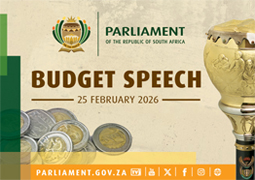
Delivering the 2026 Budget Speech in the National Assembly, the Minister of Finance, Mr Enoch Godongwana, said South Africa has reached an important turning point in the management of public finances.
He reminded Members of the National Assembly that, five years ago, the economic outlook was stark. State capture had hollowed out critical institutions and weakened state-owned entities, South Africa had been downgraded to junk status by credit rating agencies. And, meanwhile, the coronavirus pandemic and the Russia–Ukraine conflict dealt a blow to global growth. He also noted that in 2023, the Financial Action Task Force placed South Africa on its grey list. Safe to say, South Africa’s public finances were under severe strain and growth had stalled.
However, rather than letting this scenario confine them, the South African government chose turned it into a catalyst for change. “We committed to a clear reform agenda and a disciplined fiscal strategy built on three principles: stabilise debt, invest in infrastructure and spend better,” Mr Godongwana said.
This has now delivered tangible results. For the first time in 17 years, debt will stabilise and it will continue to fall in the coming years. The budget deficit has narrowed significantly, and debt-service costs are also falling.
The world has taken notice:
- South Africa has been removed from the FATF grey list;
- We secured our first credit rating upgrade in 16 years;
- And borrowing costs have eased, creating space for growth and development.
These are signals of restored credibility. Of renewed resilience. And of a nation regaining its footing. The lesson is a simple but powerful one: steady structural reform and responsible public finances are the bedrock of a prosperous and more inclusive South Africa.
Turning to the global economy, Mr Godongwana said growth is projected to be 3.3 per cent in 2026, broadly in line with last year’s outcome. Advanced economies are expected to grow moderately, while emerging markets will continue to anchor global momentum.
In response, South Africa needs to diversify its trading portfolios, secure new markets, reduce vulnerability to external shocks and position itself to benefit from emerging global growth centres.
On the domestic front, Mr Godongwana said the growth outlook is steadily improving. He said: “We project real economic growth of 1.6 per cent in 2026, an improvement from the 1.4 per cent estimated in 2025. This improvement reflects the continued strengthening of economic performance from the second half of 2025.
Over the medium term, growth is expected to average 1.8 per cent, reaching 2 per cent by 2028. Persistent logistics bottlenecks, weak public infrastructure and the recent outbreak of foot and mouth disease continue to weigh on economic activity and pose risks to the outlook.
In light of this, rapid inclusive growth remains South Africa’s only durable path forward. The government’s efforts to promote faster economic growth continue to revolve around the four pillars:
- Maintain macroeconomic stability
- Implement structural reforms
- Invest in growth-enhancing infrastructure
- Build state capacity
These pillars are the foundation upon which inclusivity is built and are how South Africa will ensure faster growth, Mr Godongwana said.
 Arrange a tour