



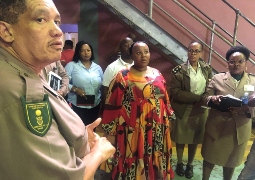
The Portfolio Committee on Correctional Services commenced its weeklong oversight programme by visiting KwaZulu-Natal (KZN) correctional facilities to assess the efficacy of the regulation framework, policies and practices that govern them, with an aim to review and make legislative recommendations on the Correctional Services Act where necessary.
This is in line with the committee’s commitment to review the accuracy of the Department of Correctional Service’s reports and make legislative recommendations for new policy or regulatory frameworks if required.
The committee started its oversight programme at Kokstad Medium Correctional Centre and thereafter visited eBongweni Super Maximum Correctional Centre, which has been hailed as the premium correctional facility in southern Africa.
Of paramount significance in these oversight visits is the committee’s duty to assess the prison conditions, facilities and rehabilitation programmes that the inmates are subjected to. This is because the conditions in the prisons are often kept away from public scrutiny.
“We are here to get assurance that these facilities are run the way they should be run … As such, the work we do demands that we collaborate with each other to ensure that there’s service delivery to both the inmates, the officials of correctional services facilities and the department’s key performance areas,” Ms Ramolobeng said.
During their walk-about inspection at Kokstad Medium Correctional Centre, members of the committee discovered that its kitchen, which also serves the eBongweni Super Maximum Correctional Centre, operates with a certificate that was issued in 2020. The Chairperson declared that the department should ensure that the Kokstad Medium Correctional Centre’s kitchen “is compliant with the required food safety standards. A certificate issued in 2020 can’t be valid in 2025.” She added: “I believe that there are policies that govern the regularity of the issuing of food safety certificates of correctional facilities. The Department of Health is an authority on this matter and should be consulted for clarity on it.”
Members also discovered two broken cooking pots that have not been replaced for two years, which has left the kitchen poorly equipped to service both prisons. When a member of the committee, Mr Sanele Mwali, asked why they were not replaced, officials blamed the centralised procurement process and Kokstad’s lack of suppliers for such equipment. When Mr Mwali pressed the correctional centre officials about whether the national department knew about this situation, correctional services official Mr Riaan Botha stated that due to budget cuts there was no allocation for them, but a new allocation has been made in this new financial year to procure them.
Meanwhile, Ms Ramolobeng praised eBongweni for its reportedly contraband-free status and encouraged other correctional facilities to use its methods as a benchmark for how to deal with contraband. However, committee member Ms Elana James noted the crisscrossing wires, radios and speakers she saw in the inmates cells and claimed they were being used to traffic contraband in plain sight. She wondered why prisons officials have allowed this to happen and also complained about the apparent lack of strategic and sustained drugs rehabilitation programmes in these facilities. The officials again took turns to respond to her concerns, but she was not entirely satisfied by what she considered as officials’ cover-up for their ineptitude.
Seeing that she was far from being satisfied with these answers, the Deputy Minister of Correctional Services, Ms Lindiwe Ntshalintshali, suggested that instead of responding imprecisely to these matters, the department will undertake to send a detailed report on its drug rehabilitation interventions and inmates’ rights in correctional facilities.
The Chairperson also criticised the haphazard and unsatisfactory way the officials of these correctional centres responded to the committee’s enquiries. “Going forward, let’s have better presentations than the messy situation we witnessed and were subjected to today. Presenters must not hide issues but should instead be honest to us so that we can assist the department where needed,” she said.
After all, she suggested, “You are accountable to this committee. It would be better,” she continued, if you “expose your hinderances to us rather than hide them. So that we can be able to assist you.” She further pleaded: “All we want is honesty and transparency. And all that we want to do is to do our oversight work, assist the department to achieve its service delivery milestones and there is nothing personal about that.”
To unlock some of the service delivery problems experienced in these correctional facilities, Ms Ramolobeng called for those important and frontline posts that are funded but remain vacant to be filled immediately. “We can’t continue to have people acting in critical operational positions indefinitely. Such critical posts must be filled with immediate effect. And the department must give us time frames; we can’t make acting a normality. These positions must be advertised and be filled, and the department must report to us on the steps taken in doing so,” she said.
Ms Ramolobeng also asked the department for a turnaround strategy to explain how it will remedy the outstanding matters raised by the committee.
Abel Mputing
26 February 2025
 Arrange a tour